Short answer: there isn’t one dominant “alumni network plugin” the way there is for forums or LMS, because an alumni network is really three things at once: a member directory, a place to ask for help or mentorship, and a way to hear about jobs. The strongest current approach is a stack: BuddyNext for the directory and profiles, Jetonomy for mentorship discussion, and WP Career Board for alumni-only job postings, all three from the same team and auto-integrated. Everything else on this list is a genuine alternative approach with its own trade-offs, not a worse version of the same thing.
Search for “WordPress alumni plugin” and you’ll mostly find generic directory or membership plugins repositioned with alumni-flavored marketing copy. That’s not a knock on them, it’s just the reality of the category: alumni networks are a use case, not a plugin type, and the right answer is usually a combination rather than a single install. This roundup covers both that combination and the realistic alternatives to it, ranked by what each actually solves rather than by marketing claims.
On this page
- Quick comparison
- What an alumni network actually needs
- Why not just use a Facebook Group or LinkedIn alumni page
- What launching this actually looks like in practice
- 1. BuddyNext (directory and profiles)
- 2. Jetonomy (mentorship and discussion)
- 3. WP Career Board (alumni job board)
- 4. BuddyPress + bbPress + WP Job Manager (DIY stack)
- 5. BuddyBoss Platform
- 6. Ultimate Member + a directory plugin
- Feature comparison: the modern stack versus the DIY stack
- Frequently asked questions
- Which approach should you actually pick
Quick comparison
Approach | Best for | Starting price | Free tier |
|---|---|---|---|
BuddyNext + Jetonomy + WP Career Board | Modern, auto-integrated full stack | Free, Pro add-ons optional | Yes, all three free cores |
BuddyPress + bbPress + WP Job Manager | Free, largest ecosystem, manual setup | Free | Yes, all free |
BuddyBoss Platform | Native mobile app for alumni | Free plugin, paid bundle | Yes, limited |
Ultimate Member + directory plugin | Directory-first, lighter weight | Free, paid addons | Yes |
What an alumni network actually needs
Before picking plugins, it helps to name what an alumni network is actually for, because that’s what should drive the stack:
- A searchable directory. Alumni need to find each other by graduation year, major, location, or industry. A plain member list without real filtering isn’t a directory, it’s a wall of names.
- A reason to come back. A directory alone gets checked once and forgotten. Discussion, mentorship requests, and job postings give people a reason to open the site more than once a year at reunion time.
- Low friction to join. Alumni are not a captive audience the way current students or employees are. Every extra signup step measurably reduces how many actually join.
- A path to paid membership, eventually. Many alumni associations charge dues or offer a paid tier for premium access. Whatever you pick should have a real path to that without a second plugin bolted on later.
- Verification without a huge administrative burden. Someone needs to confirm a new signup actually attended the institution, at least loosely. A plugin stack that supports member-type gating and a lightweight approval queue handles this without alumni relations staff manually vetting every applicant by hand.
Why not just use a Facebook Group or LinkedIn alumni page
This is the honest starting question, because it’s genuinely the lowest-effort option and plenty of alumni networks run entirely on a Facebook Group with zero WordPress involvement. It works, for a while. The problems show up later: you don’t own the member list or the data, Facebook’s algorithm decides who actually sees a given post rather than every member seeing it, and if your institution’s relationship with Facebook ever changes, so does your entire alumni network’s home.
A WordPress-based alumni network costs more setup time up front, but the directory, the discussion history, and the member data all belong to the institution running it, searchable by Google, exportable, and not subject to a platform’s changing rules. For an alumni relationship that’s supposed to last decades, that ownership matters more than it does for a short-lived community.
What launching this actually looks like in practice
Picture a mid-sized university department with roughly three thousand graduates spread across twenty years of classes. The realistic launch sequence isn’t “install everything and announce it,” it’s staged. The directory goes first: alumni relations exports what contact data already exists, seeds initial profiles, and sends one email asking graduates to claim and complete their own profile. That alone, running on BuddyNext’s free core, gives the department something concrete to point to: a real, searchable list of where people ended up.
Discussion comes next, usually a few months later, once there’s a critical mass of completed profiles to make a Q&A space worth visiting. A handful of seeded questions from staff (“What’s it like working at a Big Four firm two years out?”) give the mentorship space a reason to exist before organic questions arrive.
The job board is typically the last piece added, once a few willing alumni-run or alumni-friendly employers agree to post, because an empty job board is worse than no job board at all.
The reason this staged approach works better than launching all three at once is adoption, not technology. Members joining a network that already has all three pieces populated see something worth returning to. Members joining a network where two of the three sections are visibly empty tend to write the whole thing off on their first visit and never come back to check again. The same staged logic applies regardless of institution size, only the specific numbers and timelines shrink or grow with it.
1. BuddyNext (directory and profiles)
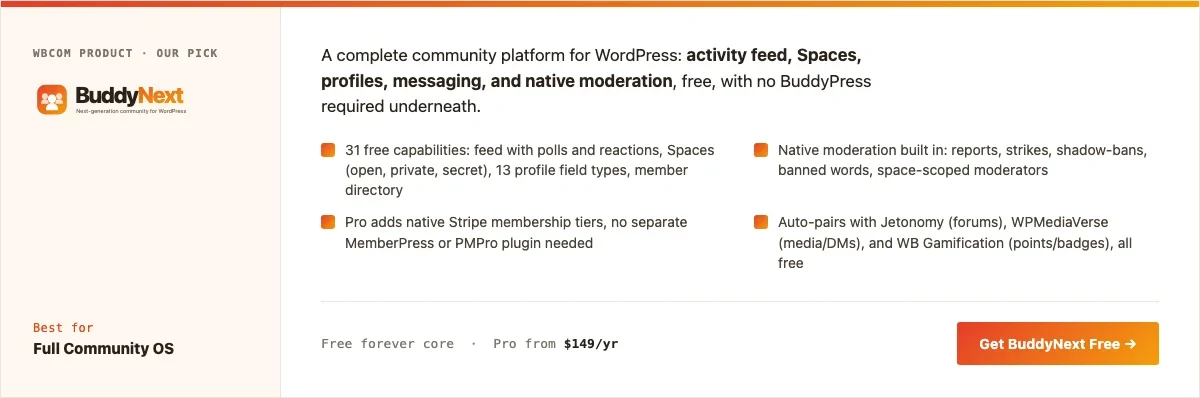
Disclosure: BuddyNext, Jetonomy, and WP Career Board are all built by Wbcom Designs, who we work with. We’re recommending this specific combination because the three genuinely auto-integrate, not because of that relationship, and the screenshots below are from a real install.
BuddyNext is the directory and profile layer of the stack: member profiles with 13 field types (meaning graduation year, major, and current employer can all be real searchable fields, not just free-text bio content), a member directory with filtering, and Spaces that can be organized by graduating class, region, or affinity group.
Here’s a real BuddyNext Spaces directory from a live install:
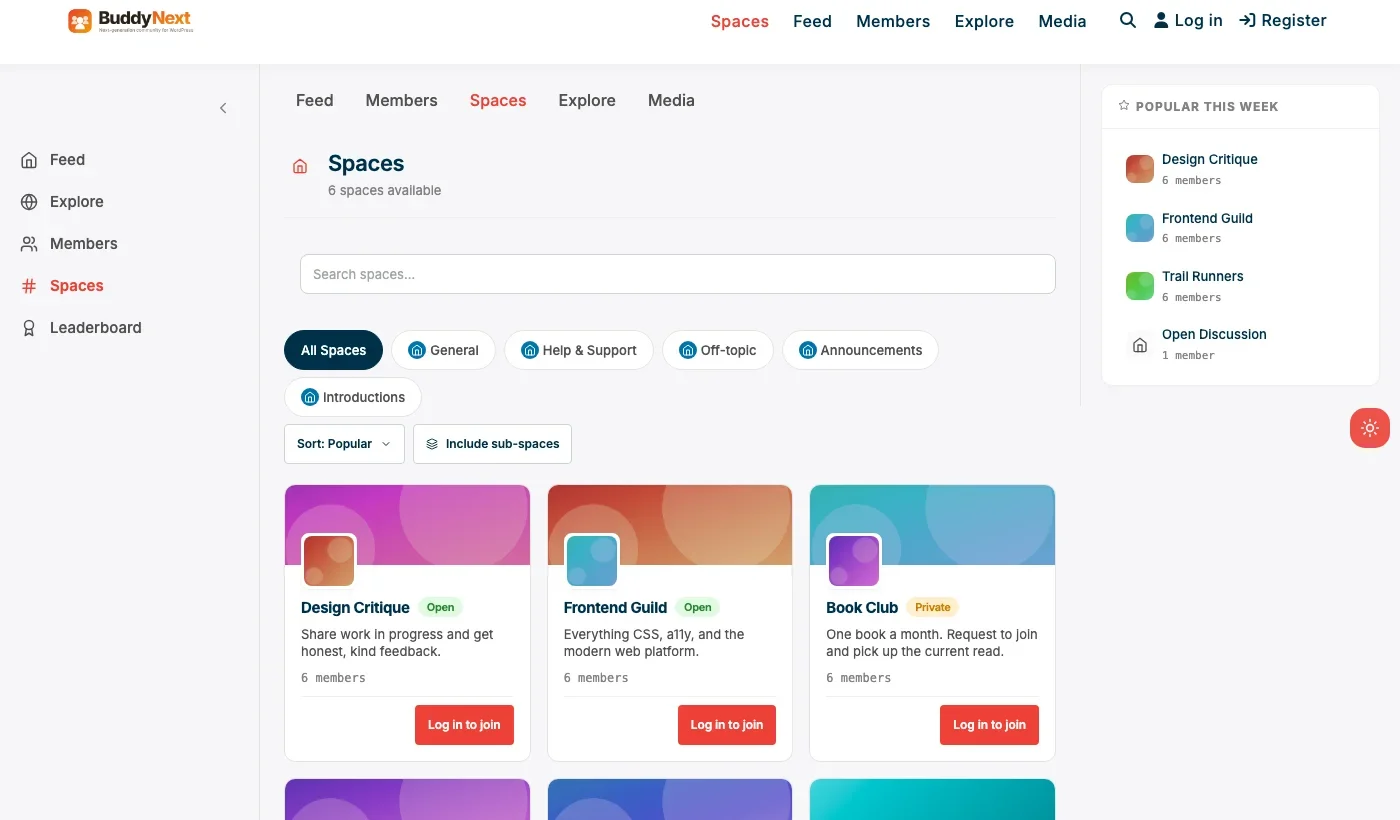
Swap “Design Critique” and “Frontend Guild” for “Class of 2015” and “Bay Area Chapter” and the underlying mechanism (real Spaces, real member counts, real join flow) is exactly what a class-and-region alumni structure needs.
Architecture note: we covered BuddyNext’s broader positioning in our WordPress community plugin roundup. The detail that matters specifically for alumni use is native moderation and member-type support being free, since an alumni directory with thousands of inactive accounts needs real moderation tooling from day one, not as a paid add-on discovered later.
What we like: real structured profile fields instead of free-text bios. Spaces model maps cleanly onto class years and regional chapters. Free core is complete enough to launch an alumni directory without paying anything.
Could be improved: on its own, BuddyNext doesn’t include forums or job boards, which is exactly why this is a stack recommendation rather than a single-plugin one.
Pricing: free core forever. Pro starts at $149/yr if you want native Stripe dues collection later.
2. Jetonomy (mentorship and discussion)
Jetonomy fills the mentorship and discussion piece: a Q&A space type with accepted answers is a natural fit for “ask an alumni mentor” style questions, separate from general discussion spaces for reminiscing or event planning. Because it auto-integrates with BuddyNext, a class-year Space can have its own linked forum without any manual configuration.
Trust levels matter more here than in a typical forum, since alumni networks often have long stretches of low activity between reunions and events; a self-moderating trust system means the network doesn’t need active staff moderation during the quiet months.
The Ideas space type is worth a specific mention for alumni associations that solicit feedback on programming, events, or scholarship priorities. Rather than an email survey nobody reads the results of, alumni can submit and vote on ideas directly, with a visible Planned-to-Shipped status that shows leadership is actually listening rather than collecting suggestions into a black hole.
What we like: Q&A mode fits mentorship requests better than open discussion. Auto-integrates with BuddyNext’s Spaces, so no separate forum setup per class or chapter. Trust levels reduce the moderation burden during low-activity periods.
Could be improved: only worth adding once the directory and profile layer is in place; it’s not a starting point on its own for this use case.
Pricing: free core forever. Pro extensions from $48.30/yr if you want AI-assisted moderation or analytics later.
3. WP Career Board (alumni job board)
Alumni-exclusive job boards are one of the highest-value things an alumni network can offer, since alumni hiring alumni is a real, recurring reason for people to stay engaged. WP Career Board covers this natively: job listings, filtering by category, location, and experience level, and company profiles that alumni-run businesses can claim.
Here’s a real job board from a live install:
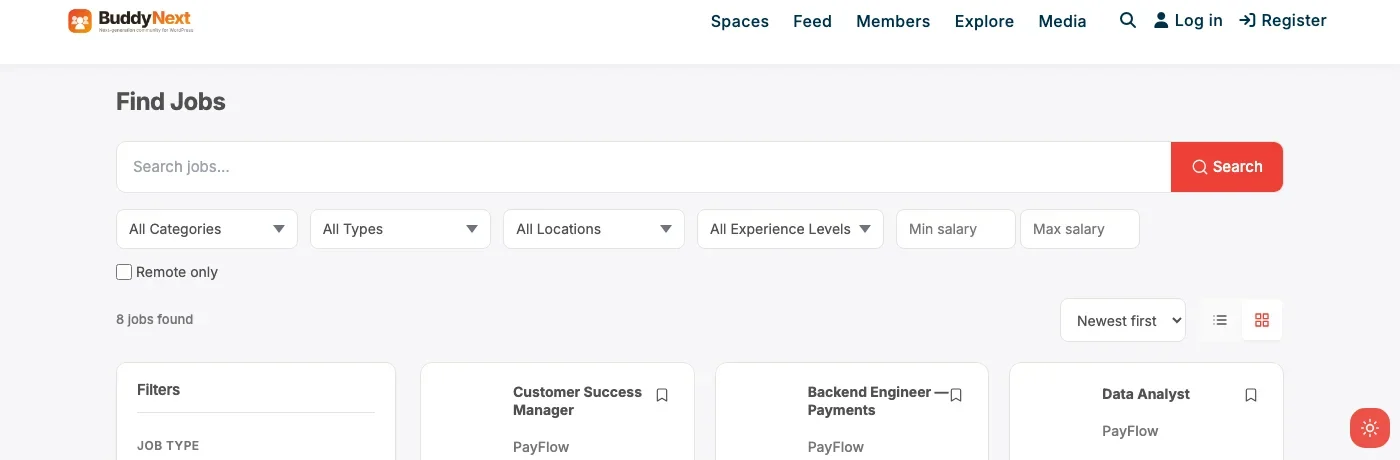
Eight real listings, real filtering by category, type, location, experience level, and salary range, not a mockup. In an alumni context, gating posting access to verified alumni (via BuddyNext’s member types) turns this into a genuine alumni-exclusive benefit rather than a generic public job board, which is a meaningfully different pitch to a graduating senior than a generic job board anyone on the internet could post to.
The company-profile piece matters more for alumni networks than most other job-board use cases. An alumni-run startup claiming its profile and posting under its own name builds exactly the kind of visible “our graduates are out there building things” narrative that alumni relations offices actively want to showcase, separate from the transactional value of the listings themselves.
What we like: real filtering and search, not a bare list. Company profiles alumni-run businesses can claim and follow. Free core covers the core listing and application flow without a paywall.
Could be improved: Pro’s Kanban application pipeline is worth it only once alumni relations staff are actively managing postings, not needed for a small volunteer-run network.
Pricing: free core forever. Pro from $48.30/yr for the applicant pipeline and credit-based posting plans.
4. BuddyPress + bbPress + WP Job Manager
This is the free, decade-tested version of the same idea: BuddyPress for profiles and groups, bbPress for discussion, WP Job Manager for listings. Every piece is free, well-documented, and has a huge ecosystem of themes and extensions behind it.
The cost is integration work. None of these three plugins were built with each other specifically in mind the way BuddyNext, Jetonomy, and WP Career Board were, so connecting a BuddyPress group to its own bbPress forum and gating WP Job Manager postings by BuddyPress member type takes manual configuration and, in some cases, a glue plugin or a small amount of custom code.
For a volunteer-run alumni association with a comfortable WordPress developer on the board, or the budget to hire one for a week of setup, this is a completely reasonable path. The ongoing maintenance burden is also higher over time, three independently-updated plugins occasionally break each other’s integrations after a major WordPress or PHP version bump in a way that a single vendor’s coordinated stack is less prone to. Budget for that ongoing maintenance explicitly rather than assuming a one-time setup is the end of the work.
What we like: completely free, no paid tier anywhere in the stack. Enormous ecosystem and community knowledge for troubleshooting. No vendor lock-in to a single company’s roadmap.
Could be improved: nothing auto-integrates; expect real setup time connecting the three. No native moderation suite across the stack, each plugin handles it differently.
Pricing: free, all three plugins.
5. BuddyBoss Platform
BuddyBoss Platform is worth considering specifically when a branded mobile app matters, alumni relations offices increasingly want an app alumni can check the way they’d check any other social app. The Platform plugin is free; the app, theme, and bundle needed to actually ship that experience are a paid annual package.
Worth being specific about what “app” actually buys an alumni office: push notifications for events and reunions that a website can’t reliably deliver, an app-store presence that reads as more legitimate to some alumni than a mobile web page, and offline access to the directory at an in-person reunion where venue wifi is unreliable. Whether that’s worth the added cost and complexity depends entirely on how digitally engaged the specific alumni population already is.
What we like: the strongest native mobile app path of any option here. Deep LMS pairing if continuing-education content is part of the alumni offering.
Could be improved: real cost is the full bundle. Heavier than necessary if a mobile app isn’t actually a requirement.
Pricing: Platform plugin free, full bundle priced annually.
6. Ultimate Member + a directory plugin
For a smaller alumni network that mainly needs “find people from my class,” without a feed, groups, or job board, Ultimate Member’s registration and profile forms paired with a lightweight directory add-on can be genuinely enough. It’s the leanest option on this list by a wide margin.
What we like: fastest, lightest setup if directory search is truly the only requirement. Best-in-class registration form builder if you need custom fields (class year, degree, major) collected cleanly at signup.
Could be improved: no discussion or job board layer without adding more plugins, at which point you’re rebuilding the BuddyNext stack piece by piece anyway.
Pricing: free core, paid addon bundles for directory and social features.
Feature comparison: the modern stack versus the DIY stack
Feature | BuddyNext + Jetonomy + WP Career Board | BuddyPress + bbPress + WP Job Manager |
|---|---|---|
Auto-integration between pieces | Yes, same team, zero config | No, manual setup required |
Structured profile fields (class year, major) | Yes, 13 field types native | Via BuddyPress xProfile, more manual |
Native moderation | Yes, free | Varies per plugin |
Job board gating by alumni status | Native via member types | Requires custom glue |
Total cost to launch | Free, Pro optional later | Free |
Frequently asked questions
Do I really need three separate plugins for an alumni network?
Not necessarily all three from day one. BuddyNext alone covers a directory and basic community. Add Jetonomy when mentorship or discussion becomes a real need, and WP Career Board when alumni hiring alumni becomes a real pattern worth supporting formally.
Can alumni-only content be gated so the public can’t see it?
Yes. BuddyNext’s private and secret Spaces, combined with member types for verified alumni, can restrict the directory, discussions, or job postings to verified members only, with public pages limited to a general information page.
What’s the cheapest way to launch a basic alumni directory this month?
BuddyNext’s free core alone: profiles, a searchable directory, and Spaces organized by class year, with zero cost and no other plugins required to start.
Is a Facebook Group really that much worse than a real fix?
For a very small, informal network, a Facebook Group is a legitimate choice and this whole comparison may be overkill. The trade-off is real once the network is large enough that ownership of the member data and independence from a platform’s algorithm start to matter.
Does this stack work for a professional association, not just school alumni?
Yes. The same directory-plus-mentorship-plus-jobs structure applies to any alumni-style network: professional associations, certification cohorts, bootcamp graduates, or corporate alumni programs all have the same underlying shape. The graduation-year field just becomes a certification date, a cohort number, or a hire date, depending on what’s actually being tracked.
How much staff time does an alumni network realistically need per week once it’s launched?
For a network in the low thousands of members, a few hours a week is typical: approving new member requests, seeding a discussion prompt if the community has gone quiet, and moderating the occasional flagged post. That number grows with member count and activity level, but it rarely approaches a full-time role until the network is genuinely large or the institution wants it to be a primary engagement channel rather than a supporting one.
How do you handle alumni whose email addresses have changed since graduation?
This is less a plugin problem than a data problem every alumni network faces. BuddyNext’s profile claim flow (matching a new signup against an existing seeded record by name and graduation year rather than email alone) helps, but expect a real percentage of records to stay unclaimed indefinitely. Budget for periodic re-engagement campaigns through whatever channels still reach people, not just the plugin stack.
Should current students be allowed into the same network as alumni?
Most institutions keep them separate, at least at first, since current students and alumni want different things from the space. BuddyNext’s member types make this straightforward to enforce technically; the harder part is a policy decision about whether the mentorship value of mixing the two outweighs the moderation complexity of doing so.
Who should actually own and run an alumni network day to day?
Technically, whoever manages the WordPress site. Practically, the network only stays alive if a real person, alumni relations staff, a volunteer board member, or a hired community manager, is responsible for seeding content, approving new members, and posting the occasional discussion prompt during quiet months. No plugin stack substitutes for that ongoing ownership.
Which approach should you actually pick
If you’re starting an alumni network from scratch and want the pieces to work together without manual glue, start with BuddyNext for the directory, and add Jetonomy and WP Career Board as mentorship and hiring become real needs rather than installing all three on day one. If budget is the only constraint and volunteer time is available for setup, the BuddyPress plus bbPress plus WP Job Manager combination gets you the same shape for zero cost.
Choose BuddyBoss Platform specifically if a branded mobile app is a real requirement from leadership, and Ultimate Member plus a directory add-on if a searchable directory is genuinely the entire scope of what you’re building.
See also our forum plugin roundup for a deeper look at the mentorship-and-discussion piece Jetonomy handles in this stack.
Related WordPress plugin guides
- Best WordPress Professional Networking Plugins, since an alumni network is really a specific kind of professional network
- Best WordPress Nonprofit Community Plugins, relevant for alumni associations that operate as nonprofits
- Best WordPress Community Directory Plugins, a closer look at the member-directory mechanics this stack relies on
Last reviewed: September 2026.



No comments yet