Short answer: if you’re building a self-hosted space for a DAO, NFT project, or token-holder community, BuddyNext is the strongest general-purpose WordPress option because its free core gives you Spaces, member types, and native moderation you can adapt into a holder-only structure, without renting space inside someone else’s Discord server. It is worth being upfront that BuddyNext does not do native on-chain wallet or NFT verification out of the box, so if real token-gating matters, pair it with a dedicated Web3 wallet-auth plugin. Discord remains the fastest way to start with zero setup, at the cost of owning none of the community’s data or uptime. Everything else on this list fits a narrower budget or verification need.
Web3 communities have a structural problem most general community plugins were never built to solve: membership is supposed to be provable on-chain, tied to a wallet holding a specific token or NFT, not just a username and password. WordPress’s plugin ecosystem for this is genuinely thin compared to Discord bots built specifically for token-gating, and this roundup is honest about that gap rather than pretending it doesn’t exist.
On this page
- Quick comparison
- What a Web3 community actually needs
- Why not just use Discord
- The honest gap: WordPress has no native on-chain gating
- Governance and moderation in a token-gated space
- What this actually looks like for different project types
- 1. BuddyNext
- 2. BuddyPress
- 3. PeepSo
- 4. Ultimate Member
- Feature comparison
- Frequently asked questions
- Which one should you actually pick
- A realistic hybrid setup that actually works today
- Content that keeps a Web3 community alive between price cycles
- Related WordPress plugin guides
Quick comparison
| Option | Best for | Native wallet gating | Starting price |
|---|---|---|---|
| BuddyNext | Owned community layer, manual/hybrid gating | No, pair with a wallet plugin | Free, Pro from $149/yr |
| Discord | Fastest start, existing bot ecosystem | Yes, via bots (Collab.Land etc.) | Free, bot fees vary |
| BuddyPress | Largest ecosystem, zero cost | No, pair with a wallet plugin | Free |
| PeepSo | Lightweight, modern out of the box | No | Free, paid modules |
| Ultimate Member | Gated directory of verified holders | No, pair with a wallet plugin | Free, paid addons |
What a Web3 community actually needs
A Web3 community has a few requirements that differ meaningfully from a typical WordPress community:
- A real path to wallet or token verification. Whether that’s a dedicated Web3 login plugin, a manual verification process backed by custom profile fields, or a hybrid of both, the community needs some mechanism for confirming someone actually holds what they claim to hold.
- Ownership independent of any single chain or marketplace. Projects that build their entire community inside Discord or a specific marketplace’s built-in chat lose that community the moment the project migrates chains, marketplaces, or hits a Discord ban.
- A structure that can represent tiers of holders. A project with a base collection and a rarer subset often wants different access levels for each, which maps onto member types or paid tiers more than a flat single membership.
- Resilience against the volatility of the space itself. Web3 projects come and go quickly. A community platform that’s cheap to run and easy to maintain matters more here than in a steadier niche, since the underlying project’s fortunes can change fast.
Why not just use Discord
This deserves an honest answer, since Discord is genuinely the default home for Web3 communities and for good reason. Bots like Collab.Land handle real on-chain wallet verification and role assignment automatically, setup takes an afternoon, and every crypto-native user already has a Discord account and knows how to use it.
The cost shows up in ownership and permanence. A Discord server can be banned, a bot integration can break or get deprecated, and Discord itself decides the platform’s future, not the project. The community’s message history, member list, and structure live entirely inside Discord’s infrastructure, with no straightforward way to export or migrate it if the project ever needs to move. For a project expecting to matter past a single hype cycle, that’s a real risk, not just a theoretical one.
A WordPress-based community trades Discord’s mature bot ecosystem for ownership: the member list, the content, the structure all live in a database the project controls. The honest trade-off, covered directly in the next section, is that WordPress doesn’t have anything close to Discord’s mature wallet-verification tooling yet, so this ownership comes at a real functionality cost today.
The honest gap: WordPress has no native on-chain gating
It would be dishonest to write this roundup without saying clearly: there is no dominant, mature, widely-adopted WordPress plugin that does what Collab.Land does for Discord, real-time wallet connection, on-chain token balance checking, and automatic role assignment, all built specifically for WordPress with broad community trust behind it. The Web3-WordPress plugin space is fragmented and immature compared to the Discord bot ecosystem.
What does exist, generically, is WalletConnect-based login plugins that let a user connect a wallet to authenticate, which some projects then pair with manual or semi-automated verification of holdings before granting community access. This is a real, workable pattern, just a more manual one than a Discord bot handling verification instantly and automatically. A project serious about WordPress-based token-gating should expect to either build custom verification logic (checking a wallet’s holdings via a blockchain API and updating a WordPress user’s member type accordingly) or accept a lightweight manual review process where an admin confirms holdings before approving access.
This gap is exactly why this roundup leads with BuddyNext as an “adapt this” option rather than a plugin, specific, purpose-built Web3 gating solution: none of the general options below solve wallet verification out of the box, and any project claiming otherwise on a general community plugin’s marketing page should be checked carefully before being trusted.
Governance and moderation in a token-gated space
Moderation looks different in a Web3 community than in most other niches on this site. Members often hold real financial stakes in the project, sometimes significant ones, which raises the emotional temperature of disagreements in a way a hobby forum rarely sees. A price dip, a delayed roadmap item, or a perceived broken promise can turn a community space contentious fast, and moderation tools built for casual discussion aren’t always enough on their own.
This is where native moderation, reports, strikes, banned-word filtering, actually matters more than it might in a lower-stakes community. A project that can quickly address bad-faith actors, coordinated FUD campaigns, or scam links posing as official announcements protects both the community’s health and, in some cases, its members’ actual money. BuddyNext’s free-tier moderation tools cover the baseline here; a project with a larger, more contentious community should budget real moderator time, not just plugin features, since no amount of tooling replaces a human making judgment calls during a genuinely heated dispute.
Transparency about moderation decisions matters more in this space too. A Web3 community that bans or mutes a member without a visible, consistent reason tends to breed suspicion that the project is silencing legitimate criticism rather than handling genuine bad behavior, which is a reputational risk specific to a space where trust in the founding team is already a live, ongoing question for most holders. A published, consistently applied moderation policy, even a simple one, goes a long way toward avoiding that perception.
What this actually looks like for different project types
It’s worth grounding this in concrete project shapes rather than abstract advice, since “Web3 community” covers meaningfully different situations. An NFT collection with a fixed supply and a single tier of holders has the simplest structure: one BuddyNext Space, one member type for verified holders, manual verification against a marketplace listing or wallet screenshot. A DAO with token-weighted voting and multiple contributor roles needs something more layered: separate Spaces for governance discussion versus general chat, member types reflecting contributor status or voting power tier, and probably a genuine custom integration if voting power needs to be reflected automatically rather than manually updated.
A play-to-earn gaming project with an active in-game economy sits somewhere in between: holders of specific in-game assets might warrant their own Space, but the core community likely still benefits from an open general area where prospective players who don’t hold anything yet can still participate, ask questions, and eventually convert into holders. Gating the entire community behind verified holdings, rather than just the exclusive sub-spaces, often shrinks a project’s own funnel by locking out exactly the people it needs to reach to grow.
The common thread across all three: start with the simplest structure that fits the project’s actual holder tiers, and resist the urge to over-engineer a gating system before there’s a real community to gate in the first place. A project polishing an elaborate token-verification pipeline before it has fifty engaged members is solving a problem it doesn’t have yet, at the expense of the actual community-building work that would get it there.
1. BuddyNext
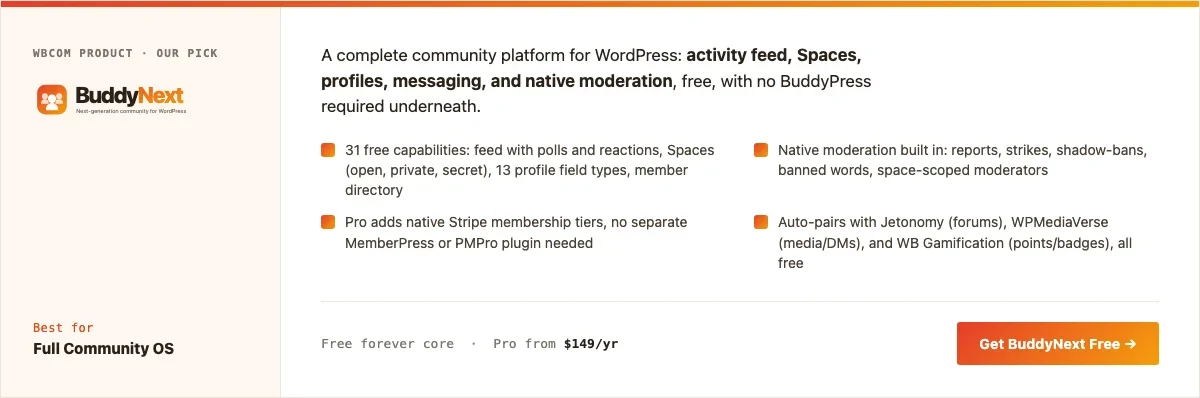
Disclosure: BuddyNext is built by Wbcom Designs, who we work with. We’re listing it here because its free core genuinely provides the community structure a Web3 project needs to adapt, not because of that relationship, and we’re being explicit that it does not include native on-chain gating.
BuddyNext’s free core gives a Web3 project the community scaffolding: Spaces that can represent different holder tiers, member types for tagging verified holders versus general members, a feed, and native moderation, none of which any Discord bot alone provides once a community needs to live somewhere the project actually owns.
Here’s a real BuddyNext Spaces directory from a live install, the same mechanism a project would adapt for holder-tier or collection-specific sub-communities:
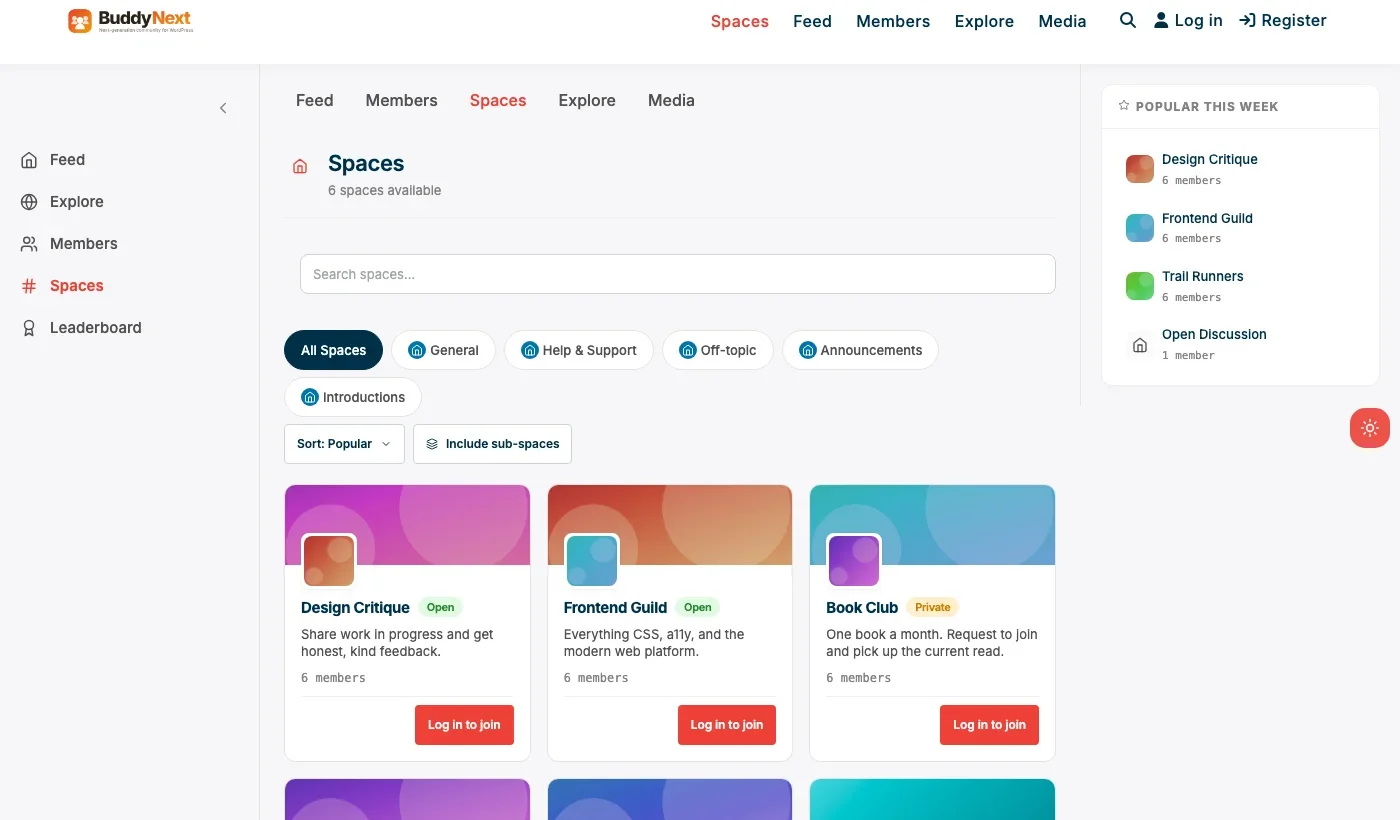
Architecture note (read this carefully): BuddyNext’s member types and Spaces are a manual or semi-automated workaround for token-gating, not a blockchain-native solution. A project would typically pair BuddyNext with a WalletConnect-based login plugin for authentication, then either build a custom integration checking on-chain holdings via a blockchain API to auto-assign member types, or run a manual verification step where an admin confirms a wallet’s holdings before approving access. This is real, workable, and used by projects today, but it is meaningfully more setup work than a Discord bot’s instant automatic verification. We covered BuddyNext’s general community positioning in our WordPress community plugin roundup.
What we like: free core provides real community structure (Spaces, member types, moderation) a Web3 project can build on. Full data ownership independent of Discord or any single chain. Native Stripe tiers in Pro if the project also wants a paid membership layer alongside holder-only access.
Could be improved: no native wallet or on-chain verification; requires pairing with a separate Web3 login solution and either custom integration work or manual verification. Smaller ecosystem of Web3-specific extensions than Discord’s bot marketplace.
Pricing: free core forever. Pro starts at $149/yr if you want native Stripe membership tiers alongside holder verification.
2. BuddyPress
BuddyPress offers the same trade-off as BuddyNext: real community structure, no native wallet gating, but with the largest available ecosystem of themes and extensions of any WordPress community plugin, which matters if a project wants a highly custom look and has developer resources to build a wallet integration on top.
What we like: zero cost forever. Largest available ecosystem for developers building custom Web3 integrations on top.
Could be improved: no native moderation suite, no native wallet gating, and no built-in monetization path; expect meaningful custom development for a serious Web3 build.
Pricing: free, always.
3. PeepSo
PeepSo’s lightweight, modern feed is worth considering for a Web3 project that wants a clean look without BuddyPress’s setup overhead, understanding it carries the same wallet-gating limitation as every general option here.
What we like: modern look without a special theme requirement. Lighter weight than BuddyPress plus add-ons.
Could be improved: no native wallet gating. Per-module pricing adds up if you need several features.
Pricing: free core, individual modules priced separately.
4. Ultimate Member
For a project mainly wanting a searchable directory of verified holders rather than a full feed and discussion space, Ultimate Member’s registration and profile system, paired with manual verification, is a lighter path than a full community platform.
What we like: fast, light setup for a directory-first use case. Strong custom registration form builder for collecting wallet address and holdings info for manual verification.
Could be improved: no discussion or feed layer without adding more plugins. No native wallet verification.
Pricing: free core, paid addon bundles for directory and social features.
Feature comparison
| Feature | BuddyNext | BuddyPress | Discord |
|---|---|---|---|
| Native on-chain gating | No, pair with a plugin | No, pair with a plugin | Yes, via bots |
| Data ownership | Full, exportable | Full, exportable | None, Discord-controlled |
| Native moderation | Yes, free | No | Yes, via bots |
| Holder-tier structure | Yes, Spaces/member types | Yes, via Groups | Yes, via roles |
| Setup complexity for gating | High, needs integration | High, needs integration | Low, established bots |
Frequently asked questions
Is there a WordPress plugin that does exactly what Collab.Land does for Discord?
Not with the same maturity and adoption. WalletConnect-based login plugins exist, but combining that with automatic on-chain holdings verification for WordPress community access typically requires custom development, not a single off-the-shelf plugin most projects have heard of.
Should a new Web3 project skip Discord entirely and go straight to WordPress?
No, for most projects. Discord’s bot ecosystem for wallet gating is far more mature today. A WordPress community makes more sense as an owned, permanent home alongside Discord, not necessarily a full replacement for it, at least until WordPress’s Web3 tooling matures further.
Can a project run both Discord and a WordPress community together?
Yes, and this is the most common realistic pattern today. Discord handles real-time chat and wallet-gated verification via bots; the WordPress site serves as an owned, permanent archive and hub the project fully controls, with manual or semi-automated syncing of verified-holder status between the two.
How do other Web3 projects handle manual verification without it being a bottleneck?
Most set up a lightweight process: a member submits their wallet address, a blockchain explorer link, or a screenshot of their holdings, and a moderator confirms and assigns the appropriate member type, often within a day. It doesn’t scale infinitely, but it works for most project sizes without custom development.
What happens to community access if a member sells their NFT?
Without automated on-chain checking, WordPress-based access doesn’t automatically revoke when holdings change hands. Projects needing that level of automated enforcement should budget for a custom integration or accept periodic manual re-verification instead.
Is it worth building a custom wallet integration for a small project?
Usually not. Custom blockchain-API integration work is a real development cost that rarely pays off for a project with a few hundred holders. Manual verification, while less elegant, is the pragmatic choice at smaller scale, and can be revisited once the project and budget both grow.
Which one should you actually pick
If you want an owned, permanent community home independent of Discord, and you’re prepared for either manual verification or custom development to handle wallet gating, start with BuddyNext’s free core. If wallet gating has to be fully automated and instant on day one, Discord’s mature bot ecosystem remains the more realistic choice today, with a WordPress presence built alongside it rather than instead of it. BuddyPress fits a project with developer resources building a fully custom wallet integration, and Ultimate Member fits a project that only needs a simple verified-holder directory.
A realistic hybrid setup that actually works today
The pattern most Web3 projects land on in practice, given the current state of WordPress’s Web3 tooling, is a hybrid rather than a single-platform choice. Discord remains the real-time home where wallet-gated bots do the heavy lifting of verification and role assignment automatically. A WordPress site running BuddyNext serves as the project’s owned, permanent presence, holding the content, announcements, and community structure that the project actually controls independent of Discord’s terms of service or any single bot’s continued existence.
Keeping the two loosely synced, a member’s Discord role reflected as a BuddyNext member type after manual or lightly automated confirmation, gives a project the best of both without pretending WordPress currently matches Discord’s gating maturity. This is worth revisiting periodically, since WordPress’s Web3 plugin ecosystem is still young and specific, trustworthy gating plugins may mature significantly over the next year or two. A project building today should treat the current setup as a reasonable starting point, not a permanent architecture decision, and stay open to migrating pieces of the verification workflow as better-tested WordPress-native tooling becomes available.
One practical detail worth planning for early: who on the team actually owns keeping Discord roles and WordPress member types in sync. Without a named owner, drift sets in quickly, a member’s role gets updated in one place after a sale or purchase and never reflected in the other, and within a few months the two systems disagree often enough that neither is fully trusted. A lightweight weekly reconciliation check, even a manual one where someone spot-checks a sample of members against both systems, catches this before it becomes a real trust problem for the community.
Content that keeps a Web3 community alive between price cycles
A pattern worth naming directly, since it’s specific to this niche: Web3 community engagement tends to track token price far more tightly than in most other community types on this site. Activity spikes during a bull run and a mint, then drops off hard during a quiet market, which can make a community feel abandoned exactly when long-term holders most need reassurance that the project is still alive and building.
The projects that weather this best treat their owned WordPress community as a place for substance, development updates, roadmap progress, behind-the-scenes building content, rather than only price-adjacent hype. A holder checking in during a quiet market who finds genuine evidence of ongoing work is far more likely to stay engaged than one who finds a ghost town, which reinforces exactly why owning a permanent, project-controlled home (rather than relying entirely on a Discord server that goes quiet along with the price) matters as much as it does for this specific niche. Scheduling a predictable cadence of substantive updates, even monthly, on the WordPress site specifically gives long-term holders a reliable place to check for real signal, independent of whatever the current market mood happens to be.
Related WordPress plugin guides
- Best WordPress Community Plugins: the general roundup this Web3-specific guide builds on
- Best WordPress Nonprofit Community Plugins: another niche where owning the platform outweighs a free incumbent’s convenience
- Best WordPress Support Group Community Plugins: a different niche facing the same “why not just use the free platform” trade-off
- Best Free WordPress Community Plugins: the full list of genuinely free options across this series
Last reviewed: September 2026.

No comments yet