Short answer: for a gaming clan, guild, or esports team that wants a real hub outside Discord, BuddyNext is the strongest WordPress option because its free core covers a searchable feed, member profiles, and Spaces for sub-squads or game titles, and it pairs directly with WB Gamification, a completely free points-and-leaderboard plugin, for the rank displays and tournament recognition gaming communities specifically care about. Discord remains unbeatable for real-time voice and quick chat, but it’s a poor home for searchable guides, tournament archives, and a member’s history of contributions. Everything else on this list fits a narrower budget or feature need.
A gaming community has a specific texture: members care about rank, recent wins, and recognition in a way most other community types don’t, and they expect a fast, visual, slightly competitive feel rather than a quiet forum. The plugin choice matters because the platform either supports that competitive, recognition-driven culture natively or it doesn’t, and bolting recognition features on after the fact rarely feels as integrated as building around it from day one.
On this page
- Quick comparison
- What a gaming community actually needs
- Why not just use Discord
- Who actually runs a WordPress gaming community
- 1. BuddyNext
- 2. WB Gamification
- 3. BuddyPress
- 4. PeepSo
- Feature comparison
- Frequently asked questions
- Which one should you actually pick
- Why a searchable tournament archive matters more than it seems
- Related WordPress plugin guides
Quick comparison
Plugin | Best for | Starting price | Free tier |
|---|---|---|---|
BuddyNext | Owned clan/guild hub, full stack free | Free, Pro from $149/yr | Yes, full core |
WB Gamification | Points, badges, leaderboards | Free forever, no Pro tier | Yes, everything |
BuddyPress | Largest ecosystem, zero cost | Free | Yes, no Pro tier |
PeepSo | Lightweight, modern out of the box | Free, paid modules | Yes |
What a gaming community actually needs
- Visible rank and recognition. Points, badges, and leaderboards aren’t a nice-to-have here, they’re close to the core product. A gaming community without visible standing feels flat compared to what members are used to in-game.
- Sub-groups by game title or squad. A multi-game clan or a guild with several raid teams needs its own Space per group, not one undifferentiated feed mixing every title and squad together.
- Searchable, permanent content. Strategy guides, build discussions, and tournament results need to be findable months later, which a real-time chat app structurally isn’t built for.
- Fast, visual presentation. Gamers expect a snappy, image-and-video-friendly feed, not a plain text wall.
- Native moderation. Gaming communities are not immune to toxicity, and a plugin without real reporting and moderation tools puts that burden entirely on volunteer admins with no system behind them.
Why not just use Discord
This deserves a direct answer, since nearly every gaming community already lives on Discord in some form, and for real-time voice coordination during a match, nothing on this list competes with it. Setup is instant, members are already there, and voice channels are genuinely excellent.
The limitation shows up the moment content needs to outlive the conversation. Discord’s search is weak, older messages effectively disappear into scroll, and none of it is indexed by Google, so a detailed strategy guide a member wrote six months ago is functionally lost to anyone who wasn’t there when it was posted. Discord also owns the platform and the data: if the server gets nuked, banned, or the community wants to migrate, there’s no clean export of the relationship or the content history.
A WordPress-based community doesn’t replace Discord, it complements it: Discord stays the real-time voice and quick-chat layer, while the WordPress site becomes the permanent, searchable home for guides, tournament results, member profiles, and rank history, the stuff that’s actually worth keeping past this week’s conversation. Most successful hybrid setups link the two directly, with a Discord bot or simple embed pointing members back to the WordPress site for anything that needs to last.
Who actually runs a WordPress gaming community
This covers a wider range of groups than it might first appear. Esports organizations running multiple teams across several titles, needing a public roster, results archive, and sponsor-facing presence. Guild or clan leaders in a specific MMO who want a real home base independent of the game’s own in-house forums, which are often neglected by the publisher. Content creators building a fan community around their own gaming brand, where recognition and rank among active fans is part of the draw. Tournament organizers who need a permanent, linkable results archive rather than a Discord thread that scrolls away.
Each of these leans on the same core mechanic: a real member directory with visible standing, tied to a searchable content layer. That’s exactly why the BuddyNext-plus-WB-Gamification combination shows up as the lead recommendation here, since it’s the free stack that covers both halves of that requirement without asking a volunteer-run clan to pay for basics.
1. BuddyNext
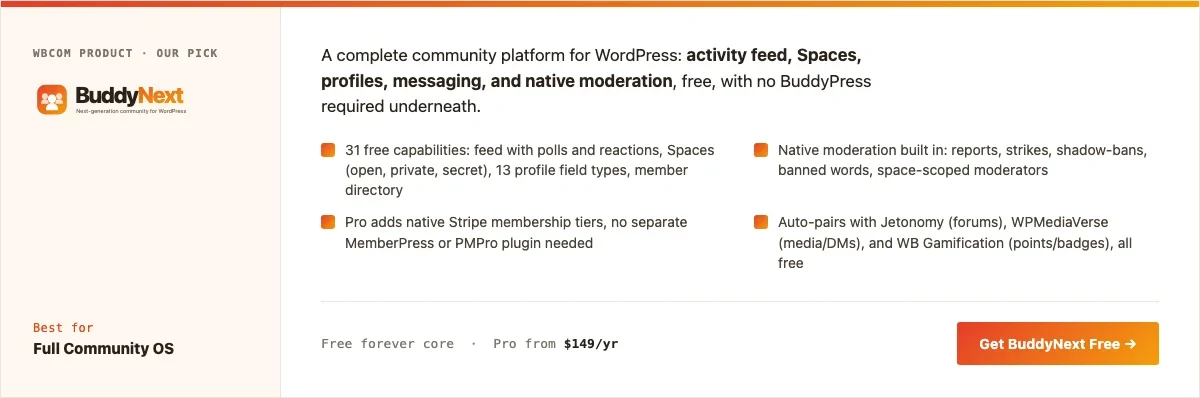
Disclosure: BuddyNext is built by Wbcom Designs, who we work with. We’re listing it here because its free tier genuinely covers a gaming community hub without add-ons, not because of that relationship.
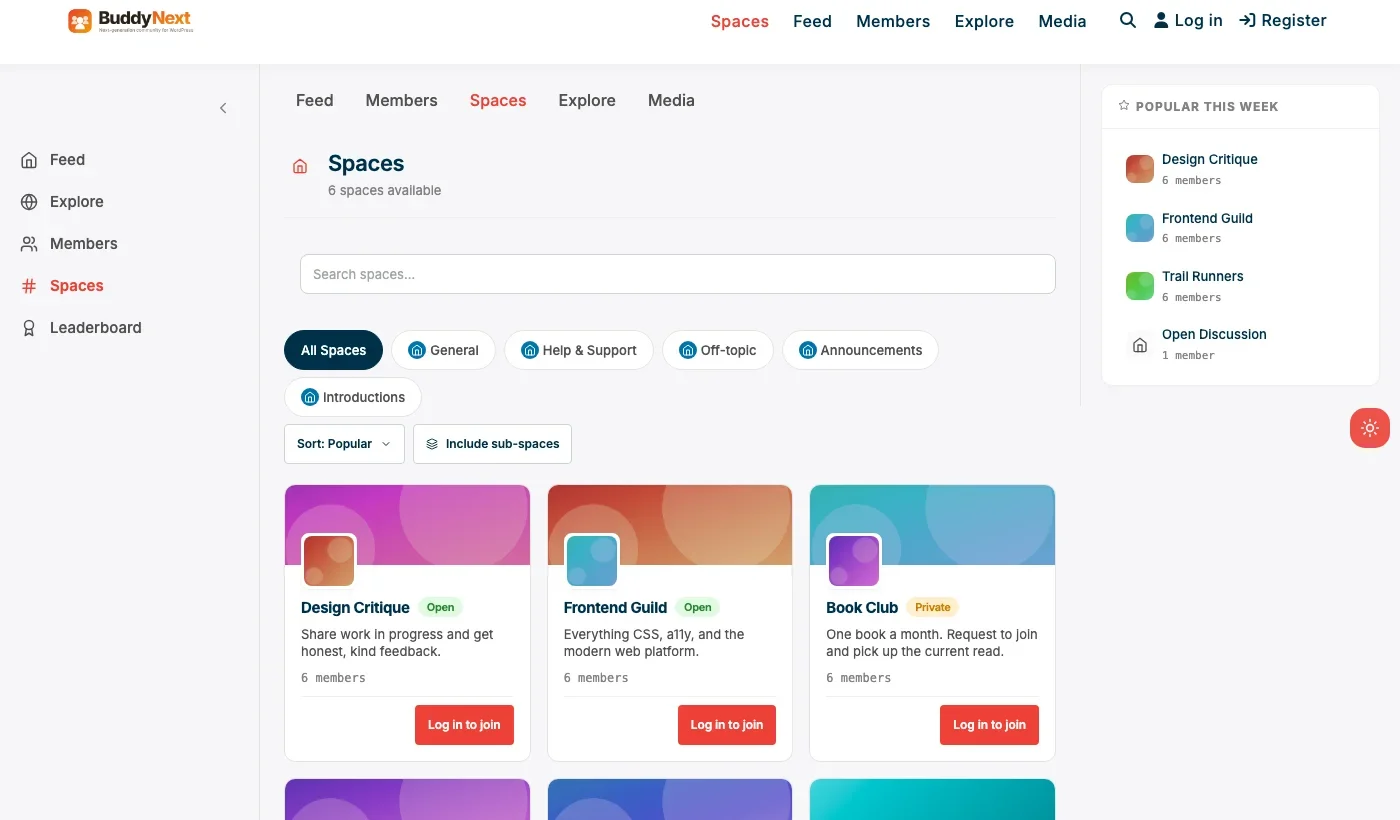
BuddyNext’s free core covers a feed, Spaces that map cleanly onto game titles or squads, member profiles, and native moderation, with no companion plugin required. For a multi-game clan, Spaces let each title’s community stay organized without needing a separate site per game.
Here’s a real BuddyNext Spaces directory from a live install, the same mechanism a clan would use per game title or squad:
Architecture note: we covered BuddyNext’s general positioning in our WordPress community plugin roundup. What matters specifically for gaming is that BuddyNext’s member types and profile fields can be repurposed for rank, main game, or role (support, DPS, IGL), and its activity feed reactions give a lightweight way for members to acknowledge a good play or a win screenshot without needing a full gamification layer for casual engagement.
What we like: free core is complete enough to launch a real gaming hub without paying anything. Spaces model fits multi-game or multi-squad clans cleanly. Native moderation matters for a community type that isn’t immune to toxicity.
Could be improved: no native points or leaderboard system, that’s what WB Gamification adds. Smaller theme ecosystem than BuddyPress.
Pricing: free core forever. Pro starts at $149/yr for native Stripe tiers if the community wants paid VIP access.
2. WB Gamification
WB Gamification adds points, badges, streaks, and leaderboards to any WordPress site, completely free, with no Pro tier at all. For a gaming community specifically, this is close to essential: tracking tournament wins, contribution points, or activity streaks with a visible leaderboard is exactly the kind of recognition gamers expect from the platforms they already use, and having it free removes any excuse not to add it.
What we like: genuinely free forever, unlike GamiPress or myCred which charge per integration. Works directly on top of BuddyNext profiles. Leaderboards and badges map naturally onto gaming recognition (MVP badges, win streaks, tournament placements).
Could be improved: it’s a recognition layer, not a community platform by itself, it’s additive to BuddyNext, not a replacement for it.
Pricing: completely free, forever, every feature included.
3. BuddyPress
BuddyPress remains a legitimate choice specifically because of its ecosystem: more themes and add-ons have been built for BuddyPress than any other WordPress community plugin, which matters if a highly specific gaming-themed layout is the top priority and a developer is available to build it. It’s completely free and backed by over a decade of documented patterns.
The trade-off is that BuddyPress alone doesn’t include native moderation, and pairing it with a separate gamification plugin (rather than one built specifically to work with BuddyNext-style profiles) sometimes needs more manual integration work.
What we like: zero cost forever. Largest available ecosystem of gaming-adjacent WordPress themes and add-ons.
Could be improved: no native moderation suite. Needs a compatible theme to look current out of the box.
Pricing: free, always.
4. PeepSo
PeepSo is worth a look for a clan that wants a clean, modern-looking feed without needing a specialized theme. Its free core covers feed, groups, and profiles, with paid modules for specific features like richer media, which matters for a gaming community that shares a lot of screenshots and clips.
What we like: modern look without a special theme requirement. Lighter weight than BuddyPress plus add-ons.
Could be improved: no native gamification layer as complete as pairing BuddyNext with WB Gamification. Per-module pricing adds up if you need several.
Pricing: free core, individual modules priced separately.
Feature comparison
Feature | BuddyNext + WB Gamification | BuddyPress | PeepSo |
|---|---|---|---|
Native moderation | Yes, free | No | No, needs add-on |
Points/badges/leaderboards | Yes, free | No, needs add-on | No, needs add-on |
Multi-game/squad Spaces | Yes, Spaces | Yes, via Groups | Yes, via Groups |
Free tier completeness | Full stack free | Full core free, narrower scope | Plugin free, modules paid |
Frequently asked questions
Should a gaming clan replace Discord with WordPress?
No, they serve different purposes. Keep Discord for real-time voice and chat, and use a WordPress community as the permanent, searchable home for guides, results, and member standing.
Can WB Gamification track tournament results specifically?
Yes, points can be awarded manually or via triggers for wins, placements, or contributions, and the leaderboard displays cumulative standing, which works well for tracking a season or ongoing tournament series.
Do members need a new login separate from Discord?
BuddyNext supports social login options, which reduces friction, though it won’t be the exact same Discord identity unless a custom integration is built.
What’s the fastest way to launch a basic gaming hub this month?
BuddyNext’s free core plus WB Gamification: install both, set up one Space per game or squad, and start awarding points for activity. That’s a real, functioning hub, not a demo.
Can a multi-game esports org keep separate leaderboards per title?
WB Gamification’s points system can be scoped, and combined with BuddyNext Spaces per title, an org can keep standings organized by game rather than one blended leaderboard across unrelated titles.
Is this overkill for a small, casual clan?
Not necessarily. Even a small clan benefits from a permanent home for guides and a simple leaderboard, and both BuddyNext and WB Gamification are free, so there’s no cost barrier to starting small and growing into more Spaces later.
Which one should you actually pick
If you’re building a real gaming community hub and want recognition, multi-squad organization, and moderation without paying for any of it, start with BuddyNext plus WB Gamification. That combination alone covers what most clans, guilds, and esports orgs need on day one. Choose BuddyPress if a highly specific gaming-themed layout backed by the largest available theme ecosystem matters more than an out-of-the-box gamification layer. PeepSo fits a group that wants a modern look with a lighter footprint and is willing to add gamification separately later.
Why a searchable tournament archive matters more than it seems
It’s easy to underestimate how much value a gaming community loses by letting its own history disappear into Discord scroll. A permanent, indexed archive of past tournament results, brackets, and write-ups does two things a Discord thread never can: it lets new members discover the community’s history and credibility when they find it via search, and it gives long-time members a lasting record of what they actually accomplished together, not just a memory that fades once the channel scrolls past it.
This is worth treating as a real content habit, not an afterthought. A short recap post after every tournament, who played, what happened, final standings, takes a coach or captain twenty minutes and builds a searchable archive that compounds in value over seasons. A clan that’s been doing this for two years has a genuinely impressive, discoverable history; one that’s relied entirely on Discord has nothing to show for the same two years beyond whatever members happen to remember.
Recruiting new members without a revolving door
Most clans and guilds treat recruitment as the hard part and retention as something that just happens if the recruit is good enough. In practice it’s usually the reverse: a mediocre player who feels genuinely welcomed and sees a clear path to belonging tends to stick around and improve, while a skilled recruit dropped into a community with no onboarding and no visible way to earn status often drifts back out within a few weeks.
A structured first-week path helps more than most clans expect: a welcome post introducing the new member to the roster, an easy first badge or points milestone they can hit within days (not months), and an explicit invitation into whichever Space matches their main game or role. WB Gamification’s points system is a natural fit for this specifically, since a new member who can see themselves climbing a leaderboard, even from a low starting rank, has a concrete reason to keep showing up that a static welcome message alone doesn’t provide. Clans that treat the first two weeks as a deliberate onboarding period, rather than assuming culture fit will sort itself out, consistently report lower early churn than ones that don’t.
Running a multi-game organization without fragmenting the community
Esports organizations and larger clans increasingly span multiple titles, which creates a real tension: members who only care about one game don’t want their feed cluttered with unrelated content from other titles, but the organization also wants a shared sense of identity that spans the whole org, not four disconnected sub-communities that happen to share a logo.
BuddyNext’s Spaces model handles this reasonably well by giving each title its own Space for game-specific content, discussion, and rosters, while the org-wide profile, points totals, and general announcements Space stay shared across every member regardless of which title they play. This mirrors how successful multi-game orgs actually operate in practice: a member is proud to represent the organization as a whole, while their day-to-day engagement happens almost entirely within their specific title’s Space. Getting this balance right from the start, rather than either forcing everything into one undifferentiated feed or splitting into fully separate sites per game, tends to produce a stronger sense of shared identity without sacrificing the focused, title-specific experience each game’s players actually want.
Handling toxicity without killing the competitive edge
Gaming communities face a specific moderation tension that’s worth naming directly: competitive trash talk is often part of the culture members genuinely enjoy, but the line between playful competitive banter and genuinely toxic behavior isn’t always obvious from the outside, and getting it wrong in either direction costs the community something real. Moderate too aggressively and the community loses the competitive energy that made it fun in the first place. Moderate too loosely and new or less-confident members quietly stop posting rather than deal with pile-ons.
The clans that handle this well tend to write down, in plain language, where their own line actually is, rather than leaving it to each moderator’s individual judgment call in the moment. A clear, specific policy (calling out a bad play is fine, personal attacks and harassment aren’t, repeated targeting of the same member gets escalated regardless of whether any single post crossed a line) gives moderators something concrete to enforce consistently, and gives members a clear expectation to hold each other to. BuddyNext’s native reporting tools make enforcement straightforward once that policy exists; the harder, more valuable work is deciding what the policy actually says before the first real conflict forces the community to improvise one.
When a content creator’s fan community overlaps with a gaming clan
A growing number of these communities sit at the intersection of two categories covered separately elsewhere in this series: a streamer or content creator building a gaming-focused fan community, where members are both fans of the creator and players who game together as a clan. This dual identity is worth planning for explicitly rather than defaulting to whichever template feels closest, since the two audiences (people who mainly watch and people who mainly play) often want genuinely different things from the same Space.
A practical approach many creators land on: a general Space for content-related discussion (new videos, stream schedules, general fan interaction) alongside a separate, opt-in Space specifically for members who want to actually play together, scrim, or compete as an organized group. This avoids diluting the gaming-focused Space with content that isn’t relevant to members who joined specifically to play, while still giving casual fans who just enjoy the content a home that doesn’t assume they’re looking for a competitive team. Creators building this hybrid model benefit from reading this guide alongside the fan club and brand community guides elsewhere in this series, since the monetization and access patterns for the fan side often look more like those categories than a pure gaming clan.
Related WordPress plugin guides
- Best WordPress Community Plugins: the general roundup this gaming-specific guide builds on
- Best WordPress Fitness Community Plugins: the other niche in this series pairing BuddyNext with WB Gamification for the exact same streaks-and-leaderboards need
- Best WordPress Gamification Plugins: a deeper look at WB Gamification, GamiPress, and myCred if points and badges are your main focus
- Best Free WordPress Community Plugins: the full list of genuinely free options across this series
Whichever path fits your clan or organization, the plugins on this list only provide the structure. The community itself gets built by the members who show up consistently, the leaders who put in the unglamorous work of moderation and recognition, and the culture that forms around both. Get the free tools in place, then let the actual gaming and camaraderie do the rest, since no leaderboard or badge system substitutes for people genuinely enjoying playing together week after week. Start with the free stack, run it for a season, and add paid tiers or additional tooling only once a real, active community actually justifies the extra cost.
None of that growth happens automatically once the plugin is installed. A clan that treats launch day as the finish line, rather than the actual starting point, tends to end up with a quiet install and a handful of test posts six months later. Budget real, ongoing time for seeding content, welcoming new members personally, and running the recognition system consistently, since that ongoing effort is what turns a technically-correct setup into a community people actually want to be part of.
A brief, honest note on moderation in gaming communities specifically
Gaming communities face a moderation challenge that’s genuinely more intense than most other niches in this series, competitive stakes and in-game frustration spill over into chat and comments in ways a book club or photography community rarely deals with. Native moderation tools (reporting, strikes, banned-word filtering) matter more here than almost anywhere else on this list, and it’s worth having a real, written escalation policy before launch rather than improvising the first time a dispute between members turns genuinely hostile.
A clear, visible code of conduct posted before launch, paired with moderators who actually enforce it consistently rather than only when a situation becomes visible enough to demand attention, does more to keep a gaming community healthy long-term than any single plugin feature. Members who see toxic behavior tolerated once tend to assume it’s tolerated generally, which is a much harder reputation to reverse than to prevent in the first place.
Last reviewed: September 2026.

No comments yet