Short answer: for a gym, fitness coach, or challenge-based accountability group, BuddyNext paired with WB Gamification is the strongest WordPress combination because Spaces handle challenge cohorts and paid membership tiers while WB Gamification adds streaks, badges, and leaderboards for workout consistency, all completely free at the core. A private Facebook Group remains the fastest way to start with zero setup, but it hands the member relationship, the algorithm, and the ad-free experience to a platform you don’t control. Everything else on this list fits a narrower budget or feature need.
A fitness community lives or dies on consistency: members show up because they see other people showing up, and because small wins get noticed. That changes what actually matters in a plugin. A feed that just posts updates isn’t enough; the platform needs a way to make consistency visible and rewarding, not just a place to chat.
On this page
- Quick comparison
- What a fitness community actually needs
- Why not just run a private Facebook Group
- Who actually runs a fitness community
- 1. BuddyNext
- 2. WB Gamification
- 3. BuddyPress
- 4. PeepSo
- Feature comparison: the community-plus-recognition stack
- Frequently asked questions
- Which one should you actually pick
- Designing a challenge people actually finish
- Related WordPress plugin guides
Quick comparison
Plugin | Best for | Starting price | Free tier |
|---|---|---|---|
BuddyNext | Owned fitness community, full stack free | Free, Pro from $149/yr | Yes, full core |
WB Gamification | Streaks, badges, leaderboards | Free, no Pro tier exists | Yes, everything |
BuddyPress | Largest ecosystem, zero cost | Free | Yes, no Pro tier |
PeepSo | Lightweight, modern out of the box | Free, paid modules | Yes |
What a fitness community actually needs
A fitness community plugin gets judged on criteria specific to how accountability groups and challenges actually run:
- Visible progress and streaks, not just posts. A member who’s worked out five days in a row wants that visible, since the streak itself is part of what keeps them showing up on day six.
- Cohort structure for challenges. A 30-day challenge needs its own space, separate from the general community and from whichever challenge ran last month, so new participants aren’t wading through unrelated history.
- Recognition that doesn’t require staff to run manually. A coach or gym owner running a growing community can’t personally congratulate every member on every milestone; automated badges and leaderboards handle the volume a person can’t.
- A real path to paid membership. Many fitness communities eventually gate premium coaching content or accountability groups behind a paid tier, and the plugin needs a real answer for that without a second plugin.
Why not just run a private Facebook Group
This deserves an honest answer, since a huge number of fitness communities and coaching accountability groups live entirely inside a private Facebook Group today, and it works for plenty of them. Setup takes minutes, members already have accounts, and there’s no hosting to think about.
The costs show up as the group grows or as a coach starts charging for access. Facebook’s algorithm decides how many members actually see a given post, not the group admin. There’s no way to build a genuine paid-tier structure inside a Facebook Group without a separate payment tool that isn’t actually connected to group access. And a coach running a paid program inside a free Facebook Group has no real way to automatically remove access when someone stops paying, which becomes a real operational headache as the business grows.
A WordPress-based fitness community trades that convenience for ownership and structure: every member record, every streak, every badge lives in a database the coach or gym controls, and paid access can be tied directly to whether someone’s subscription is active. For a coach or gym building a real recurring-revenue business around community and accountability, that structural fit tends to matter more than Facebook’s zero-setup convenience once the community passes a certain size.
Who actually runs a fitness community
It’s worth being specific about who this serves. Independent personal trainers running online coaching programs who want clients to see and cheer for each other’s progress, not just interact one-on-one with the coach. Gyms and studios wanting a members-only space that extends the in-person relationship online between visits. Challenge creators running seasonal programs (a January reset challenge, a summer-ready challenge) who need each cohort to have its own space and its own leaderboard. Run clubs, cycling groups, and other activity-specific communities organizing around a shared physical activity rather than a formal coaching relationship.
Each of these leans on the same core mechanic: visible, shared progress that turns individual effort into a group experience. This is exactly why the plugins that win this comparison pair a real community layer with a real recognition layer, rather than either one alone. A feed without recognition undersells the accountability; recognition without a feed has no social context for why the badge matters.
1. BuddyNext
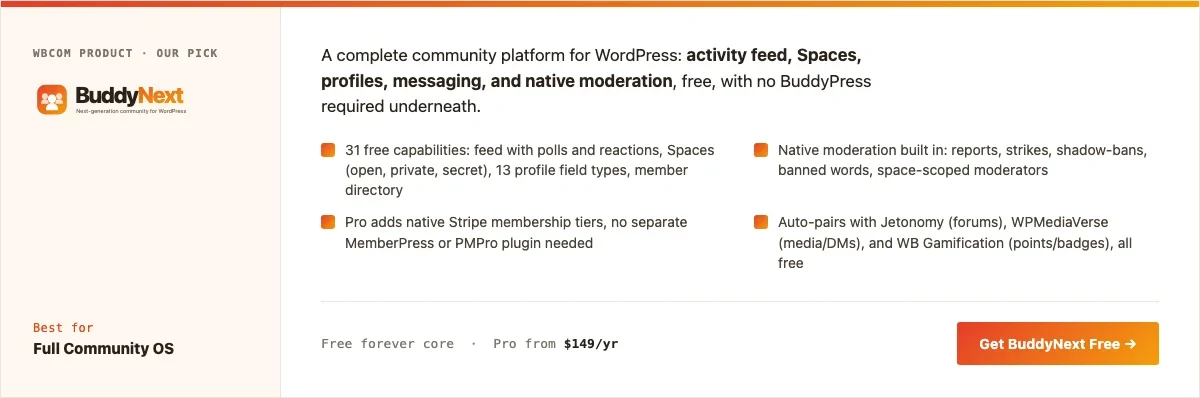
Disclosure: BuddyNext is built by Wbcom Designs, who we work with. We’re listing it here because the Spaces-plus-Pro-tiers combination genuinely fits a fitness community, not because of that relationship.
BuddyNext’s free core covers what a fitness community needs at the foundation: an activity feed for progress posts, Spaces that map cleanly onto individual challenges or membership tiers, member profiles, and native moderation, all included with no companion plugin required. BuddyNext Pro’s native Stripe tiers handle paid coaching membership directly, so access can be tied to an active subscription rather than managed manually.
Architecture note: we covered BuddyNext’s general positioning in our WordPress community plugin roundup. What’s specific to fitness is pairing Spaces with WB Gamification below: a challenge Space plus a leaderboard turns a static group into something people check daily to see where they rank.
What we like: free core is complete enough to launch a real fitness community without paying anything. Spaces model fits challenge cohorts and membership tiers cleanly. Native moderation keeps the space civil as it grows.
Could be improved: no built-in streak or badge tracking on its own; needs WB Gamification for the recognition layer this niche specifically wants.
Pricing: free core forever. Pro starts at $149/yr for native Stripe membership tiers.
2. WB Gamification
WB Gamification adds points, badges, streaks, and leaderboards to any WordPress site, completely free, with no Pro tier at all. For a fitness community, this is the layer that actually makes consistency visible: a workout streak that resets if you miss a day, a badge for finishing a 30-day challenge, a leaderboard showing who’s been most consistent this month.
What we like: genuinely free forever, unlike GamiPress or myCred which charge per integration. Works on top of BuddyNext or standalone WordPress. Streak tracking specifically fits fitness accountability better than a generic points system alone.
Could be improved: it’s a recognition layer, not a community platform by itself; it’s additive to BuddyNext, not a replacement for it.
Pricing: completely free, forever, every feature included.
3. BuddyPress
BuddyPress remains a legitimate choice for a fitness community specifically because of its ecosystem: more themes have been built for BuddyPress than any other WordPress community plugin, which matters if visual customization is the top priority and a developer is available to implement it. It’s completely free and backed by over a decade of documented patterns.
The trade-off is that BuddyPress alone doesn’t include native moderation or a monetization path, both of which a growing paid coaching community tends to need. Expect to add a membership plugin and a gamification plugin separately as the community matures.
What we like: zero cost forever. Largest available ecosystem of community-focused WordPress themes. Mature, well-documented architecture.
Could be improved: no native moderation suite. No built-in monetization or recognition system; expect to assemble multiple plugins.
Pricing: free, always.
4. PeepSo
PeepSo is worth a look for a coach who wants a clean, modern-looking community without needing a specialized theme, and without BuddyPress’s full setup overhead. Its free core covers feed, groups, and profiles, with paid modules available for specific features like gamification-style engagement.
What we like: modern look without a special theme requirement. Lighter weight than BuddyPress plus add-ons. Active development.
Could be improved: gamification and streak tracking are paid modules rather than the free, dedicated tool WB Gamification offers. No native monetization as complete as BuddyNext Pro’s Stripe tiers.
Pricing: free core, individual modules priced separately.
Feature comparison: the community-plus-recognition stack
Need | Best tool | Cost |
|---|---|---|
Challenge cohort Spaces | BuddyNext | Free |
Streaks and badges | WB Gamification | Free forever |
Paid coaching membership | BuddyNext Pro | $149/yr |
Native moderation | BuddyNext | Free |
Leaderboards | WB Gamification | Free forever |
Frequently asked questions
Do BuddyNext and WB Gamification actually integrate, or do they just sit side by side?
They work together on the same WordPress site, with WB Gamification tracking activity (posts, logins, custom actions like a workout check-in) and awarding points, streaks, and badges that display on member profiles inside the BuddyNext community, giving members a reason to check the feed daily.
Can a coach charge for access to the fitness community?
Yes, with BuddyNext Pro’s native Stripe tiers, a coach can gate the full community or specific challenge Spaces behind a paid membership, with automatic access removal if a subscription lapses.
What’s the fastest way to launch a basic fitness community this month?
BuddyNext’s free core plus WB Gamification: install both, create one challenge Space, set up a simple streak or points rule for check-ins, and invite existing clients. No other plugin is required to have something real to show on day one.
Do members need a mobile app to check in daily?
For most fitness communities, a well-built mobile web experience is enough; members checking in via a bookmarked mobile site works fine for daily use. A dedicated app is worth the extra cost mainly for gyms with a large enough member base to justify the ongoing development cost.
How does a leaderboard avoid discouraging less-active members?
Consider a leaderboard scoped to a specific challenge or time window rather than all-time totals, and consider highlighting streaks and personal-best badges alongside the ranked leaderboard, so consistency and personal improvement get recognized even for members who aren’t at the top.
Should a gym run one community for all members, or separate ones per program?
A single community with Spaces per program (a Space for a specific class type, a Space for a specific challenge) usually works better than fully separate installs, since it keeps one member directory and lets members discover other programs they might join.
Which one should you actually pick
If you’re building a fitness community today, start with BuddyNext for the community layer and add WB Gamification immediately for streaks and badges; the combination costs nothing and covers what this niche specifically needs better than either tool alone. Add BuddyNext Pro once you’re ready to charge for access. BuddyPress fits a coach who wants a highly specific theme and has developer time to assemble the rest. PeepSo fits a coach who wants a modern look with a lighter footprint and is comfortable paying for gamification as a module rather than using the free dedicated tool.
Designing a challenge people actually finish
No plugin fixes a challenge nobody finishes. A 30-day challenge with no clear daily action, no visible way to track progress, and no moment of public recognition at the end will underperform a much simpler challenge that has all three. The platform’s job is to remove friction from a program the coach has already designed well, a clear daily or weekly action, a streak that’s genuinely visible to the participant, and a real close-out moment (a final leaderboard, a completion badge, a shoutout post) that makes finishing feel like it mattered.
Worth planning deliberately: what happens after a challenge ends. A challenge Space that just goes quiet the day after it closes loses the momentum it built. Moving graduated participants into an ongoing general Space, or immediately opening enrollment for the next challenge while motivation is still high, captures far more repeat participation than letting the group go dormant and hoping people come back next season on their own.
Handling the members who stop seeing results
Every fitness community eventually has members who show up consistently but stop seeing visible progress, and how the community handles that moment matters more than any single feature on this list. A leaderboard and streak system that only rewards visible physical results (weight lost, PRs hit) can quietly punish exactly the members who most need continued encouragement, since a plateau is a normal, expected part of any real fitness journey, not a sign the program has failed them.
The communities that retain members best build recognition around consistency and effort, not just outcomes. A streak badge for showing up, independent of whether this week’s numbers improved, gives a plateauing member something genuine to feel good about besides a stalled scale. Coaches running these communities well make a point of publicly acknowledging effort-based wins, someone who modified a workout around an injury and still showed up, someone who’s maintained a habit for three months even without dramatic visible change, since that kind of recognition is what keeps a member in the program long enough to eventually break through the plateau instead of quietly dropping out during it.
Handling body and health data with real care
A fitness community often involves members sharing information they’d consider more sensitive than a typical social post, weight, measurements, injuries, or health conditions relevant to their training. This deserves the same seriousness other sensitive-content communities in this series get, even though fitness doesn’t always get framed that way by default.
Practically, this means giving members real control over what’s visible to the group versus what stays private between them and a coach. A member should be able to post a workout win without being forced to disclose a specific number if they’d rather not, and progress photos or measurements shared with a coach for accountability purposes shouldn’t automatically become visible to the entire community unless the member chooses to share them there. BuddyNext’s field-level profile privacy, the same mechanism covered in this series’ support-group and professional-networking guides, applies just as directly here: let members choose what’s public, what’s coach-only, and what stays entirely private, rather than defaulting everything to fully visible because the platform didn’t make privacy the easy choice.
Keeping the community alive between challenge cycles
Many fitness communities run in seasonal bursts, a January reset challenge, a summer-ready program, a fall training block, with real energy during the active weeks and a noticeable drop-off in between. That gap matters more than coaches often realize, since a community that goes quiet for two or three months between challenges loses momentum that has to be rebuilt from scratch each time, rather than compounding season over season.
A light evergreen presence between challenges tends to solve most of this: a standing general Space where members can post regardless of whether an official challenge is running, an occasional recognition post for someone’s personal milestone outside a formal program, and an early preview of the next challenge posted a few weeks before it starts to rebuild anticipation. Coaches who treat the off-season as genuinely dormant time, rather than a lighter-touch continuation of the same community, tend to see each new challenge launch cold, re-explaining the platform and re-earning trust with members who technically joined months earlier but never really stuck around. A little consistent presence between cycles pays for itself at the start of every new challenge.
Where a fitness community’s responsibility actually ends
It’s worth being explicit about a boundary many coaches blur without meaning to: a fitness community, even a well-run one with genuine accountability and support, isn’t a substitute for medical guidance, and a coach isn’t a member’s doctor or physical therapist. Members will sometimes ask training-adjacent health questions in a community setting that really need a qualified professional’s input, an injury that isn’t healing as expected, a symptom that seems unrelated to normal training soreness, a medical condition that affects what exercise is actually safe.
Coaches who run these communities responsibly draw that line clearly and consistently: enthusiastic encouragement and accountability within the community, paired with a clear, standing reminder that anything genuinely medical gets referred out to an actual healthcare provider rather than answered inside the group. This isn’t just a liability consideration, though it is that too, it’s also what keeps the community’s actual value proposition, peer accountability and shared effort, from drifting into territory neither the platform nor the coach is actually equipped to handle well.
Related WordPress plugin guides
- Best WordPress Community Plugins: the general roundup this accountability-focused guide builds on
- Best WordPress Gaming Community Plugins: the other niche in this series pairing BuddyNext with WB Gamification for the exact same streaks-and-leaderboards need
- Best WordPress Gamification Plugins: a deeper look at WB Gamification, GamiPress, and myCred if streaks and badges are your main focus
- Best Free WordPress Community Plugins: the full list of genuinely free options across this series
What actually signals a healthy fitness community
It’s worth defining success beyond raw member count, since a large but inactive community delivers less real value than a smaller, genuinely engaged one. The metrics worth actually tracking are participation-based, not vanity numbers: what percentage of active members posted or reacted in the last week, how many members completed the most recent challenge versus how many started it, and whether streak lengths are trending up or down across the community over time.
A coach who watches these numbers regularly catches problems early, a challenge with an unusually low completion rate signals something about the challenge design itself, not just individual willpower, and a declining weekly-active percentage signals a community that’s losing momentum before it becomes an obvious problem. Treating these as real operating metrics, checked on a regular cadence rather than only noticed when something’s gone visibly wrong, is what separates a fitness community a coach actively manages from one that’s simply left running and hoped for the best. A short monthly review, even fifteen minutes against these numbers, catches drift long before it turns into a community that’s quietly gone dormant.
Last reviewed: September 2026.


No comments yet