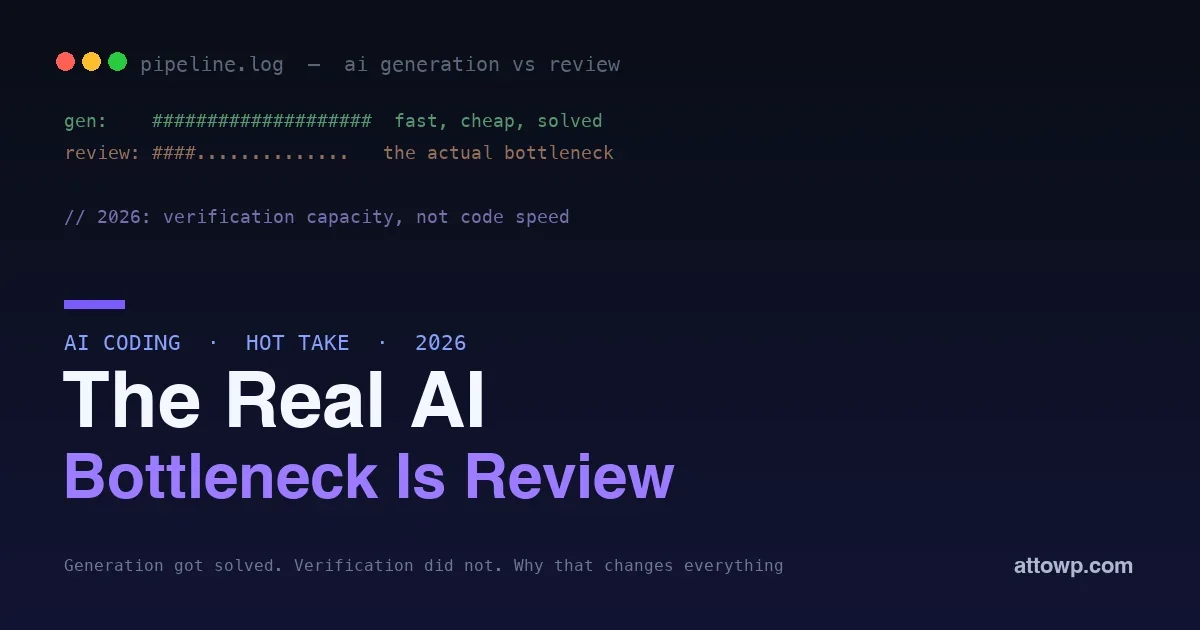
For two years the story of AI coding has been about speed: how fast a model can turn a prompt into working code. By 2026 that race is essentially won. Copilot, Claude, and Cursor generate code faster than any human could type it, and the developer conversation on Hacker News and elsewhere has quietly moved past “can it write code” to a harder question nobody markets: who is going to check all of it. The bottleneck in AI-assisted development is no longer generation. It is verification, and that shift changes how teams should actually work.
This is the contrarian point worth sitting with. Making code faster to produce does not make software faster to ship, because the constraint moved downstream. When generation was slow, writing was the bottleneck and review was cheap by comparison. Now writing is nearly free and review is the expensive, human, un-automatable part. Optimizing the half that was already solved while ignoring the half that now dominates is how teams end up faster at producing code and no faster at shipping trustworthy software.
Why generation stopped being the constraint
The numbers tell the story. A developer can prompt a model and get a working function, a component, or an entire endpoint in seconds. Whole features that once took a day of typing appear in minutes. Generation is fast, cheap, and for well-specified tasks, reliable enough. That is a genuine achievement, and it is why AI coding tools sell so well.
But producing code was never the hard part of software. Understanding it, trusting it, and being sure it does the right thing safely, that is the hard part, and AI made a lot more of it. Every block a model produces still has to be read, understood, and verified by someone who is accountable for it. The faster the model generates, the more of that verification work piles up, and there is no model that removes the need for a human to be responsible for what ships.
The metrics trap
Part of why teams optimize the wrong half is that generation is easy to measure and verification is not. Lines of code, pull requests opened, features scaffolded, these go up when you add AI, and they look like progress. The cost lands somewhere that does not show on a dashboard: reviewers stretched thin, subtle bugs shipped, incidents weeks later, trust in the codebase eroding. Optimizing for the visible number while the real constraint sits in the invisible column is a classic way to feel faster while getting slower.
A better measure is throughput of trustworthy change: how much code you ship that you are genuinely confident in. That number does not move just because you generated more; it moves when your ability to verify keeps pace. Teams that track confidence rather than volume make different, better decisions about where to spend their AI budget, and they stop mistaking activity for progress.
Verification does not scale like generation
Here is the asymmetry at the heart of the problem. Generation scales beautifully: point more compute at it and you get more code. Verification does not. Reading and truly understanding code is a human activity that runs at human speed, and it is cognitively harder than writing, because you have to reconstruct intent you did not form yourself. A developer can generate ten times more code than they used to. They cannot review ten times more code in the same day.
That gap is where the risk lives. When a team leans on AI to generate far more than it can carefully review, the surplus does not vanish; it ships under-reviewed. And under-reviewed AI code is exactly where the security and correctness problems concentrate, as the data on AI-generated code being more likely to be vulnerable shows. The faster you generate without expanding your capacity to verify, the more unverified code you push into production. Speed on one side without capacity on the other is not acceleration; it is debt.
Why polished output makes it worse
Verification of AI code is uniquely hard for a reason that sounds trivial but is not: the output looks finished. Human-written code that is rough signals where to look; a junior’s messy function invites scrutiny. AI writes clean, confident, well-formatted code even when it is subtly wrong, and polish lowers a reviewer’s guard exactly when it should be raised. The reviewer’s instinct, honed on human code, reads tidy as trustworthy. With AI output that instinct is miscalibrated, and the bugs that slip through are the plausible-looking ones nobody thought to question.
So verification of AI code is not just more work; it is harder work per line than reviewing a human. You cannot skim it, because the surface gives you no signal. You have to actually reason about whether it is correct, which is the slow, expensive activity the whole pipeline now depends on.
What the shift looks like in practice
Consider two teams with the same AI tools. The first treats generation as the win: developers prompt aggressively, accept large blocks quickly, and push them into review at a volume the reviewers cannot keep up with. Velocity looks great for a month, then the incidents start, the reviewers burn out, and the team slows to a crawl cleaning up code nobody fully understood. The second team caps how much unreviewed code is in flight, invests in tests and static analysis so the machine handles the mechanical checks, and treats human review as the paced, valued centre of the workflow. It generates less headline code and ships more software it can stand behind.
The difference is not talent or tooling; both had the same. It is which half of the pipeline they treated as the constraint. The second team read the bottleneck correctly and organized around it, and over any horizon longer than a month it wins, because trustworthy throughput compounds while cleanup debt drags.
What this means for how you work
If verification is the constraint, then the way to go faster is to expand and strengthen verification, not to generate even more. That reframes a lot of decisions:
- Generate less, more deliberately. Producing more code than you can review is not productivity; it is unreviewed risk. Match generation to the review capacity you actually have.
- Invest in automated verification. Static analysis, type checking, and a strong test suite are how you scale part of review with the machine instead of the human. They catch the mechanical failures so human attention goes to logic and intent.
- Treat review as the skilled work, not the chore. In an AI workflow, reading and judging code is the high-value activity. Staff it, reward it, and give it time, rather than treating it as a formality after the “real” work of generating.
- Keep a human accountable per change. Someone has to understand and own each merge. The model is a fast author; it is never the responsible party.
The teams that get ahead with AI are not the ones generating the most code. They are the ones whose verification keeps pace with their generation, so the code they ship is actually trustworthy.
Where tooling actually helps
The right response to a verification bottleneck is to expand verification, and tooling is how you scale the part that can be automated. Type systems catch whole classes of error before a human looks. Static analysis and linters enforce the security and correctness rules a model tends to skip. A thorough test suite turns “does this work” from a manual judgement into an automatic check that runs on every change. None of these replace human review, but they shrink what human review has to cover, letting scarce human attention focus on intent and logic rather than mechanics. For WordPress specifically, the same discipline that keeps a codebase ready for platform shifts like the move to React 19 pays off here: strong types, tests, and static checks are what let you accept AI-generated code without accepting AI-generated risk.
The WordPress angle
This is not abstract for WordPress developers. AI now writes a large share of the plugins, themes, and snippets running on live sites, and WordPress code has specific verification demands: capability checks, input sanitization, output escaping, nonce verification, prepared queries. A model reliably handles the happy path and quietly skips the security-relevant lines, which are precisely the ones a reviewer must not miss. The verification gap is where WordPress vulnerabilities are being introduced right now. Pairing AI generation with a real review gate, and increasingly with AI-aware tooling like the abilities and MCP setups that let agents inspect a site under controlled permissions, is how you keep the speed without shipping the risk.
Does this apply to solo developers, not just teams?
Even more so. A solo developer is both the generator and the only reviewer, so the verification bottleneck is entirely on one person. Leaning on tests and static analysis matters most when you are the whole review process, because there is no one else to catch what you miss when you accept AI output too quickly.
Won’t slowing down generation hurt my productivity?
Not if you measure productivity as shipped, trusted software rather than code produced. Generating more than you can verify is not productive; it is deferred risk that surfaces as incidents later. Matching generation to verification capacity is what actually keeps you fast over any real timeframe.
Frequently asked questions
Can’t AI just verify its own code?
Partially, and it helps, but it is not a substitute for human accountability. A model can flag obvious issues and generate tests, yet the research on iterative AI code shows security can degrade when you keep asking a model to fix itself. Someone accountable still has to judge whether the code does the right thing, which is the part that does not automate away.
Does this mean AI coding tools are overhyped?
No, the generation is genuinely valuable. The hype is in assuming faster generation equals faster delivery, when the constraint moved to verification. Used with strong review, AI tools are a real gain; used as a reason to ship more unreviewed code, they create debt. The tool is good; the workflow around it is what teams get wrong.
How do I expand verification capacity?
Lean on automation for what it can catch, static analysis, type checkers, and thorough tests, so human review focuses on logic, intent, and security rather than mechanics. Then treat human review as first-class work with real time allocated. You expand capacity by combining machine checks with well-supported human judgment, not by reviewing faster.
Is this just a temporary problem until AI gets better at review?
The generation-verification asymmetry is structural, not a passing limitation. Even as models improve at review, accountability for shipped software stays human, and understanding code will remain slower than producing it. Better tools will help at the margins, but the core shape of the problem, easy to make, hard to trust, is likely to persist.
What is the single most useful change to make?
Stop measuring output by code produced and start measuring it by code shipped with confidence. That one reframe pushes you to right-size generation, invest in tests and static analysis, and treat review as the valuable work, which is exactly what the verification bottleneck requires.
How does this change what skills matter for developers?
Reading, reasoning about, and judging code become the premium skills, more than raw typing speed or syntax recall, which the model now handles. The developer who can quickly tell whether a block of generated code is correct, secure, and appropriate is worth more in an AI workflow than the one who can produce the most of it. Verification is becoming the core craft.
The bottom line
AI solved the wrong half of software and called it a revolution. Generating code is fast, cheap, and largely done; verifying that code is correct, secure, and does what you meant remains slow, human, and now dominant, because there is so much more code to check. The teams that win with AI are not those generating the most, but those whose verification keeps pace with their generation. Generate deliberately, automate the checks you can, treat review as the skilled work it has become, and keep a human accountable for every change. The bottleneck moved. The teams that move with it ship trustworthy software fast; the ones still optimizing generation just ship more risk, faster.


No comments yet