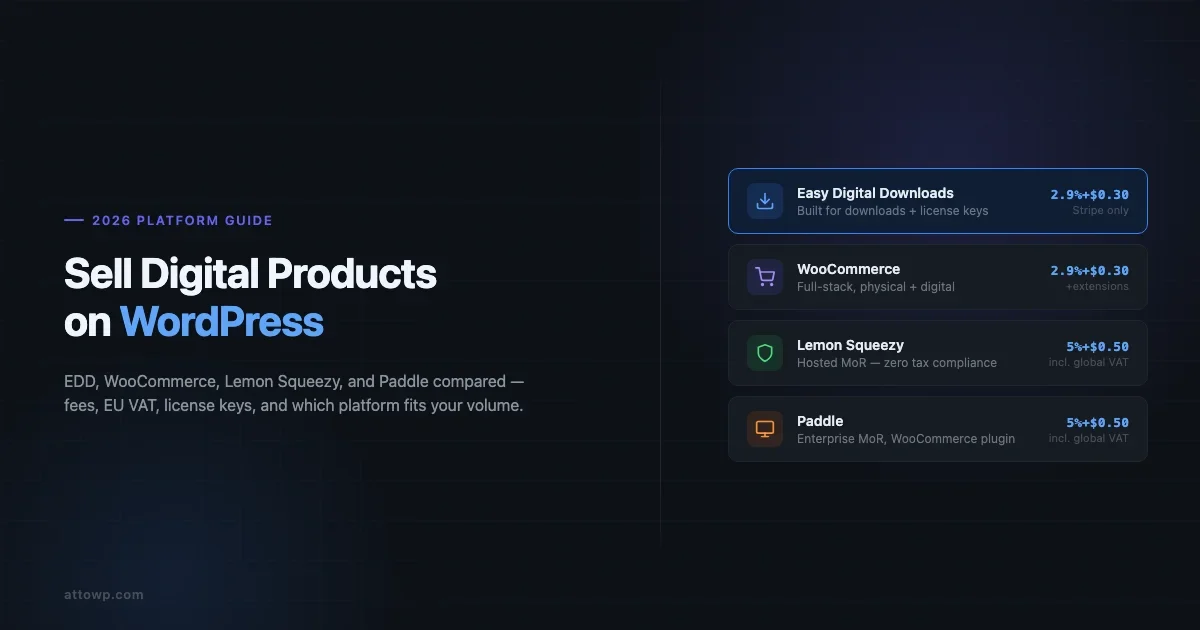
If you want to sell digital products on WordPress in 2026, you have four serious options: Easy Digital Downloads, WooCommerce, Lemon Squeezy, and Paddle. Each one handles the core mechanics differently, and choosing the wrong one costs you real money, either in transaction fees, dev hours, or tax compliance headaches. This guide breaks down exactly what each platform does well, where it falls short, and which type of seller each one fits best.
What “Selling Digital Products on WordPress” Actually Means
A digital product is anything delivered as a file or access credential: a PDF, a WordPress plugin ZIP, a software license key, a video course download, a Figma template, an ebook, or a font bundle. The delivery mechanism separates this category from physical goods and from services.
Three things matter most when picking your stack:
- How the file gets to the buyer - protected download link, S3 presigned URL, or CDN-gated asset
- How tax compliance works - especially EU VAT OSS, where a buyer in any EU country triggers a filing obligation regardless of your location
- How payment processor fees stack up - Stripe, Paddle, and Lemon Squeezy charge differently and some act as Merchant of Record, shifting the tax burden off you
This article focuses purely on downloadable files, license keys, and software. If you are building a course platform, that is a different architecture covered in the guide to selling online courses with WordPress and LearnDash. If you need a multi-vendor marketplace, the WooCommerce and Dokan marketplace guide covers that path.
Easy Digital Downloads (EDD): Built for One Thing
Easy Digital Downloads shipped in 2012 with a single mandate: sell downloadable files through WordPress cleanly. Thirteen years later that focus is still its biggest advantage. The core plugin handles file storage, purchase receipts, download link generation, and a basic license key system without any of the physical-goods overhead that WooCommerce carries.
How EDD Delivers Files
By default, EDD stores files in a protected directory under wp-content/uploads/edd/ and generates signed download URLs that expire after a configurable window. A buyer clicks “Download”, WordPress generates a token-authenticated URL, and the file streams through PHP. This works well at low volume but becomes a bottleneck past a few hundred concurrent downloads.
For higher-volume stores, the Amazon S3 extension offloads file storage to S3 and generates presigned URLs on checkout. Download requests go directly to S3, bypassing your web server entirely. Combined with a CloudFront distribution layer, this is the production-grade setup for selling plugin ZIPs or large asset bundles.
License Key Delivery with Software Licensing
The Software Licensing add-on (bundled in Extended+ plans) adds a license key API to every purchase. It lets you generate unique keys per purchase with configurable activation limits, verify license validity via a REST endpoint from inside your plugin, handle key renewals and upgrades, and set per-site activation caps. This is the stack most WordPress plugin authors use, the API is documented, widely integrated, and predictable.
EDD Pricing and Transaction Fees
EDD itself charges no transaction fees on top of your payment processor. You pay only the Stripe or PayPal rate (2.9% + 30 cents per US transaction). The annual license tiers:
Plan | Price (per year) | Transaction fee | Key add-ons included |
|---|---|---|---|
Personal | $99.50 | None | Core downloads |
Extended | $199.50 | None | EU VAT, Software Licensing, Stripe Pro |
Professional | $299.50 | None | All Extended + Recurring Payments, Frontend Submissions |
All Access Pass | $499.50 | None | All extensions |
When EDD Makes Sense
- You are selling WordPress plugins, themes, or software with license key requirements
- Your product is a ZIP file, PDF, font pack, or similar direct download
- You want the simplest possible checkout flow without physical goods complexity
- You want to stay self-hosted and keep full control over buyer data
WooCommerce for Digital Products: Capable but Heavyweight
WooCommerce was not designed for digital-only stores. It evolved from a physical goods platform and layered digital download support on top. That history shows in the admin interface, checkout flow, and extension requirements. But WooCommerce’s scale, over five million active installs and deep WordPress integration, means it can handle digital products well if configured correctly.
Setting Up Digital Downloads in WooCommerce
In WooCommerce, a digital product is a simple or variable product with the “Virtual” and “Downloadable” checkboxes ticked. Once enabled, you can attach file URLs, set download limits per purchase, and set an expiry window in days. The default delivery method streams files through PHP, inefficient for large assets. The WooCommerce Amazon S3 Storage plugin ($79/year) adds direct S3 presigned URL delivery, which is the production-grade approach.
License Key Delivery with WooCommerce
WooCommerce has no native license key system. Your main options are License Manager for WooCommerce (free on WordPress.org) and the official WooCommerce Software Add-On ($79/year). If you are building a WordPress plugin that phones home for license validation, test the API response times carefully, EDD’s Software Licensing has a longer and more battle-tested track record here.
WooCommerce Transaction Fees and Extension Overhead
WooCommerce core is free. WooPayments charges 2.9% + 30 cents per US transaction with additional surcharges for international cards. The real cost is extensions: Amazon S3 ($79/year), a license manager ($79/year), EU VAT compliance ($89/year), subscriptions ($199/year). A full-featured WooCommerce digital store can reach $500–$700/year in extensions before hosting.
When WooCommerce Makes Sense for Digital Products
- You already have a WooCommerce store selling physical goods and want to add digital products without a second platform
- You need complex product variants (e.g., different license tiers as variations)
- You need multi-vendor digital product sales (WooCommerce + Dokan handles this)
- Your team is already familiar with WooCommerce administration
Lemon Squeezy: Hosted Checkout, Merchant of Record
Lemon Squeezy is not a WordPress plugin, it is a hosted platform that handles your storefront, checkout, payment processing, and tax compliance. The fundamental difference from EDD and WooCommerce is that Lemon Squeezy acts as the Merchant of Record. They collect and remit VAT, GST, and sales tax to every applicable jurisdiction globally. You receive payouts already net of taxes and fees, eliminating your compliance burden entirely.
How Lemon Squeezy Handles Downloads and Licenses
Files live on Lemon Squeezy’s CDN, not your WordPress server. License keys are a native feature with a validation API at https://api.lemonsqueezy.com/v1/licenses/validate. The trade-off: if you leave the platform, you need to migrate files and invalidate existing download links. For software that phones home for validation, you are dependent on Lemon Squeezy’s API uptime.
Lemon Squeezy Fees and WordPress Integration
Lemon Squeezy charges 5% + 50 cents per transaction, no monthly cost. At a $49 product price, that is $2.95 per sale vs approximately $1.72 for EDD + Stripe. At 100 sales/month the difference is $123/month. But if you are spending $500/year on EDD extensions or employing an accountant for quarterly OSS returns, the math can flip quickly.
Three integration paths with WordPress: the Lemon.js overlay (paste a script tag, link buy buttons), the third-party WP Lemon plugin (blocks and shortcodes), or Webhooks + REST API (custom entitlement systems, user role grants on purchase).
When Lemon Squeezy Makes Sense
- You sell to a global audience with significant EU, UK, or Australian buyers and want zero tax compliance overhead
- You are a solo creator or small team and do not want to maintain a WordPress checkout stack
- Your products are primarily software licenses or high-margin digital goods where a slightly higher fee is worth reduced operational complexity
Paddle: The Enterprise-Leaning MoR Alternative
Paddle occupies the same Merchant of Record space as Lemon Squeezy but targets slightly larger software businesses. The rate is the same (5% + $0.50), global tax compliance is included, and Paddle integrates with WooCommerce via the official Paddle plugin and with EDD via a community extension, meaning Paddle can function as a payment processor inside your existing WordPress cart rather than replacing it entirely.
Paddle has broader seller country availability than Lemon Squeezy in certain jurisdictions, making it worth checking first if Lemon Squeezy is unavailable in your market.
Platform Fee Comparison at a Glance
Platform | Transaction fee | Monthly cost | Tax compliance included |
|---|---|---|---|
EDD + Stripe | 2.9% + $0.30 (Stripe only) | $0 (after license cost) | Manual / add-on required |
WooCommerce + WooPayments | 2.9% + $0.30 (US cards) | $0 (after extensions) | Partial / add-on required |
Lemon Squeezy | 5% + $0.50 | $0 | Full global MoR coverage |
Paddle | 5% + $0.50 | $0 | Full global MoR coverage |
EU VAT and OSS: What Every Digital Seller Needs to Know
Under the EU VAT One Stop Shop rules (effective July 2021), any business selling B2C digital services cross-border within the EU owes VAT in the buyer’s country once cumulative cross-border sales exceed EUR 10,000/year. Above that threshold, you register for OSS in one EU member state and file a single quarterly return covering all EU sales. VAT rates vary from 17% (Luxembourg) to 27% (Hungary) for electronic services.
Non-EU sellers face a stricter rule: the EUR 10,000 threshold applies only to EU-based businesses for intra-EU cross-border sales. A US-based developer selling to a French consumer technically owes French VAT from the first sale. In practice, enforcement focuses on meaningful revenue, but the legal obligation exists from day one.
Both EDD’s EU VAT add-on and WooCommerce’s VAT compliance plugins collect the two required pieces of location evidence (IP geolocation + payment card billing country), validate EU VAT numbers via VIES for B2B reverse charge, and generate compliant invoices. Lemon Squeezy and Paddle handle all of this as MoR with no action required on your end.
Decision Framework: Which Platform Fits Your Situation
Do you need a WordPress-native experience?
If your buyers are WordPress users who expect a familiar checkout, or if you need deep integration with user roles, BuddyPress, MemberPress, or other WordPress plugins, you need EDD or WooCommerce. Lemon Squeezy’s checkout overlay does not integrate with your WordPress user system without custom webhook handling.
Are license keys central to your product?
If yes and you are selling WordPress plugins or themes, EDD + Software Licensing is the mature, well-documented path. The license key API is what most plugin marketplaces integrate against. WooCommerce + a license plugin is viable but adds a dependency layer. Lemon Squeezy’s license API works but puts your validation infrastructure off-site.
How significant is your EU buyer base?
Under EUR 10,000/year in EU B2C digital sales, any platform with a VAT add-on handles compliance. Above that threshold, the quarterly OSS filing workload is real. Lemon Squeezy or Paddle’s MoR model eliminates it at the cost of higher per-transaction fees and, in Lemon Squeezy’s case, file custody.
What is your transaction volume?
- Under 50 transactions/month: Any platform works. EDD Personal at $99.50/year has the lowest overhead.
- 50-500 transactions/month: EDD Extended or WooCommerce with proper extensions. Evaluate whether EU VAT exposure justifies a Lemon Squeezy migration.
- 500+ transactions/month: The extension costs and tax compliance burden become significant enough to re-evaluate the self-hosted vs hosted trade-off seriously. High-volume sellers with mostly international buyers often find Lemon Squeezy or Paddle more economical at this tier.
Self-Hosted vs Hosted: The Core Trade-Off
Factor | Self-hosted (EDD / WooCommerce) | Hosted (Lemon Squeezy / Paddle) |
|---|---|---|
Customer data ownership | Full control, in your WordPress DB | Platform holds purchase records |
Checkout customization | Full control (CSS, HTML, hooks) | Limited to platform UI |
File storage | Your server or S3 | Platform CDN |
EU VAT / global tax | Manual setup or add-on | Automatic, zero effort |
License key system | Add-on or built-in (EDD) | Native |
Payout timing | Instant (Stripe) | Weekly or per threshold |
Platform risk | You own the stack | Vendor lock-in on files + keys |
CDN-Protected File Delivery: Making Self-Hosted Downloads Scale
If you choose EDD or WooCommerce and sell large files at any meaningful volume, PHP-streamed downloads will not hold up. The production-grade architecture for self-hosted digital product delivery looks like this:
- Store files in a private Amazon S3 bucket. Block all public access at the bucket level. No object should be publicly readable via S3 URL, access goes through your application only.
- Front S3 with CloudFront as the CDN layer. CloudFront serves bytes from edge nodes near the buyer. Create a distribution with Origin Access Control (OAC), the current replacement for the older Origin Access Identity, so CloudFront can read private objects without exposing the bucket.
- Generate presigned S3 URLs at purchase time. EDD’s S3 extension generates these automatically. They expire in a configurable window (10-60 minutes works for most use cases), enough for the buyer to begin the download, short enough that forwarded links stop working quickly.
- Set download expiry in EDD or WooCommerce settings to match your support policy. Three to five downloads per purchase with a 24-hour link expiry covers most legitimate re-download scenarios without leaving persistent public URLs in the wild.
This stack handles hundreds of concurrent downloads without touching your WordPress server’s PHP workers. The cost for S3 storage plus CloudFront bandwidth is typically a few dollars per month at indie developer scale, under 50 GB delivered per month. For WordPress plugin authors in particular, the same S3/CloudFront infrastructure can serve both the purchase download and the automatic update ZIP that your plugin fetches from EDD’s Software Licensing update API. No need for separate infrastructure for your update endpoint.
IAM Permissions for EDD S3 Integration
Create a dedicated IAM user for EDD with the minimum required permissions: s3:GetObject and s3:PutObject on the specific bucket only. Do not use root account credentials. Store the access key ID and secret in EDD’s settings, not in wp-config.php where other plugins can read them. If your hosting environment supports environment variables or a secrets manager, use those instead of the WordPress options table.
For CloudFront signed URL policies, set an IP range restriction only if your buyers are geographically concentrated, for a global audience, IP restriction causes too many false failures with mobile users on changing IPs. A time-based expiry alone is sufficient for most digital product delivery scenarios.
Recurring Revenue: Subscriptions and Annual Licenses
All four platforms support recurring revenue, but the implementation varies significantly. EDD’s Recurring Payments add-on (included in the Professional and All Access plans) handles annual and monthly subscription billing through Stripe or PayPal. License key renewals can be linked to subscription billing, when a subscription renews, EDD automatically extends the license expiry. This is how most premium WordPress plugin authors run annual license renewals without manual intervention.
WooCommerce Subscriptions (/year) provides the same capability for WooCommerce-based stores, with more flexibility for complex subscription scenarios like variable billing dates or free trials. Lemon Squeezy and Paddle both support subscriptions natively at the platform level, with subscription management, dunning (failed payment retries), and cancellation flows handled on their end. The MoR advantage applies to recurring billing as well, tax collection on each renewal payment is automatic.
Common Mistakes to Avoid
- Storing download files in a web-accessible directory without protection: Files in
wp-content/uploads/without URL-based access control are publicly accessible to anyone who guesses the URL. EDD’s protected directory and WooCommerce’s token system prevent this. - Skipping EU VAT until you get a compliance notice: The OSS threshold accumulates faster than most developers expect. Set up collection from day one.
- Using Lemon Squeezy for WordPress plugin updates without an offline fallback: If Lemon Squeezy’s API is down, your plugin’s license check should fail open, show a warning but not break functionality.
- Mixing self-hosted and Lemon Squeezy for the same product: Two separate license namespaces creates a support nightmare. Keep one canonical license API per product.
- Ignoring refund rates in your fee math: Stripe’s chargeback fee ($15 per dispute) affects your real cost per transaction.
The Bottom Line for WordPress Freelancers and Plugin Authors
For most WordPress plugin authors selling software with license keys, EDD with Software Licensing is still the right default choice. The ecosystem integration is mature, the license key API is what the WordPress world expects, and you retain full data ownership. Budget for the Extended plan ($199.50/year) to cover EU VAT and Software Licensing from the start.
WooCommerce makes sense if you are already running a WooCommerce store or need product variations and complex pricing rules. The extension overhead is real, but WooCommerce’s flexibility is genuinely broader than EDD’s.
Lemon Squeezy is the right answer if you are a solo creator selling primarily to a global audience, do not want to maintain a checkout stack, and are comfortable with the higher per-transaction fee in exchange for zero tax compliance work. Paddle is worth evaluating as the MoR alternative with slightly broader seller country coverage and tighter WooCommerce/EDD integration.
The worst outcome is delaying the platform decision and ignoring EU VAT until a compliance problem forces your hand. Choose deliberately, implement tax collection from launch, and add CDN-based file delivery before you hit the volume where PHP-streamed downloads start causing server load problems.
If you are scaling your WordPress development into a full agency model, the platform choice becomes part of a larger infrastructure decision. The post on scaling your WordPress freelance business from solo to agency covers how that stack evolution typically looks in practice.
Frequently Asked Questions
Can I use EDD and Lemon Squeezy together on the same WordPress site?
Technically yes, but you would have two separate customer records, two license namespaces, and two separate tax reporting streams. That complexity is hard to justify. Pick one per product line and stick with it.
Does WooCommerce charge extra fees for digital downloads?
WooCommerce itself charges no transaction fee. WooPayments charges the standard Stripe rates (2.9% + $0.30 for US cards) plus surcharges for international cards. Using Stripe for WooCommerce directly avoids the WooPayments surcharge and gives you Stripe’s direct rates.
How does EDD Software Licensing handle lifetime licenses?
EDD Software Licensing supports lifetime licenses natively. Set the pricing option duration to “Lifetime”, configure an unlimited or high activation cap, and the key never expires. Renewal emails are suppressed automatically.
What is the OSS threshold for non-EU sellers?
Non-EU sellers have no minimum threshold. The EUR 10,000 floor only applies to EU-based businesses for intra-EU cross-border sales. A US or UK developer owes the buyer’s country VAT from the first EU sale, the threshold does not apply to you.
Next step: Once you have your digital product platform chosen and revenue flowing, the natural expansion path is the multi-vendor marketplace layer. The guide to building a WordPress marketplace with WooCommerce and Dokan covers how to open your store to third-party sellers, useful context for agency developers whose clients want to run platforms rather than individual shops.

No comments yet