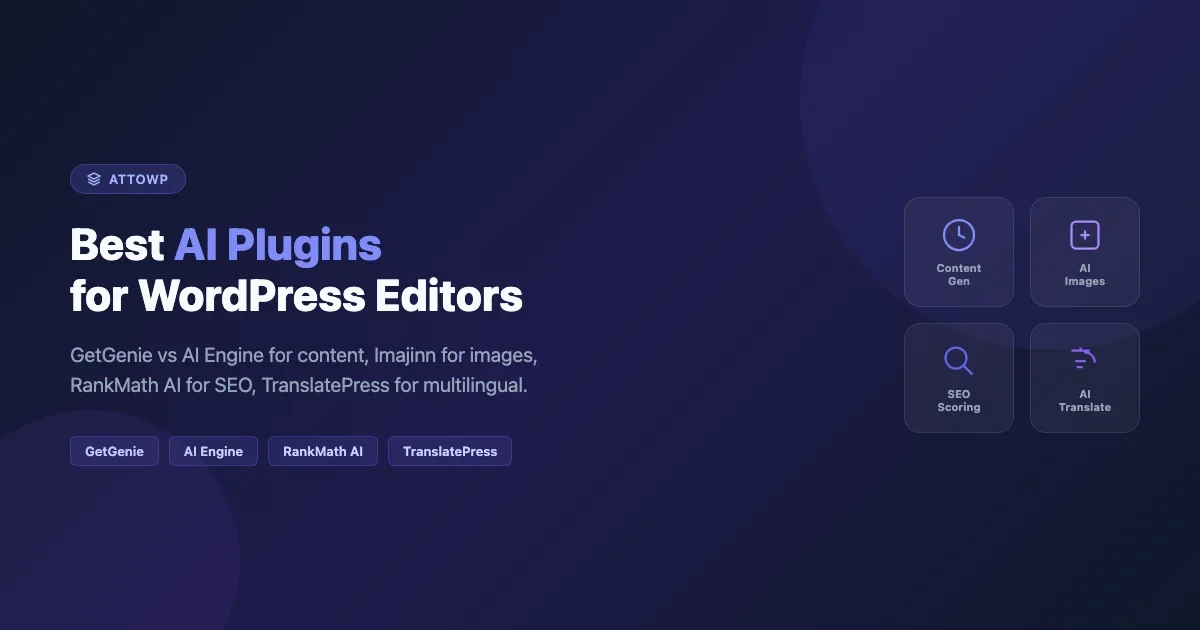
Your developer picked the stack. Your hosting is sorted. Now the writers, marketers, and agency clients sitting inside the WordPress editor are asking: which AI plugins actually help us produce better content faster? This guide covers the editor-side AI layer - the tools that live in the wp-admin writing environment and address content generation, image creation, SEO scoring, and translation. No code assistants, no terminal windows.
Why Editor-Side AI Is a Different Problem
Developer-focused AI tools (Claude Code, Copilot, Cursor) solve the problem of writing PHP and JavaScript faster. They live in a terminal or an IDE. Most content editors never open those environments.
Editor-side AI lives inside the Gutenberg block editor or the classic editor. It speaks in paragraphs, meta descriptions, alt text, and content briefs - not function signatures. The selection criteria are also different: does it integrate with RankMath or Yoast? Does it generate images that fit WordPress media library conventions? Does the output sound like a human wrote it?
Four plugin categories cover the main jobs content teams actually need done in 2026: content generation, AI image creation, on-page SEO scoring, and translation. This article benchmarks one or two leading plugins per category and gives you a clear picture of when each one earns its seat on the site.
If your team also wants a deeper look at the developer tooling side - the AI tools that help agencies build and maintain WordPress codebases - that is covered in the companion piece: Best AI Tools for WordPress Development.
Category 1: AI Content Generation Plugins
Content generation plugins sit directly in the Gutenberg toolbar or add a sidebar panel. The editor highlights a section, requests a paragraph rewrite, and the AI outputs blocks. The two plugins that see the most real-world use in late 2025 and into 2026 are GetGenie and AI Engine by Jordy Meow.
GetGenie
GetGenie positions itself as a Gutenberg-native AI writer with over 30 content templates built specifically for WordPress editors. It runs on its own cloud model (backed by OpenAI GPT-4o), so there is no API key management for non-technical users - the plugin handles authentication through a GetGenie account.
- Block integration: Adds a GetGenie panel to the Gutenberg sidebar. Editors can write a one-line brief and expand it into a full section, or use the “GenieMode” one-click article writer for longer drafts.
- SEO mode: GetGenie includes a keyword research tab that pulls search volume and competition data without leaving wp-admin. It is not a full RankMath replacement, but it surfaces actionable SERP data during the writing session.
- Templates include: product descriptions, landing page sections, email subjects, YouTube scripts, and long-form blog posts.
- Pricing: Free plan available (limited credits). Paid plans start at roughly $9/month for 5,000 words.
Where GetGenie earns its keep is on sites that publish at high volume - marketing agencies managing 10+ client blogs, or editorial teams running daily publishing schedules. The integrated keyword research means writers can research and draft without switching tabs.
Where it can frustrate: the output defaults to a fairly generic English voice. Teams with a strong editorial identity spend time rewriting tone, which partially offsets the generation speed gain. The plugin also requires a stable internet connection; there is no offline or local-model option.
AI Engine by Jordy Meow
AI Engine takes a different philosophy: it acts as a configurable bridge to whichever AI API the site owner prefers. OpenAI, Anthropic Claude, Google Gemini, Mistral, Ollama (local models) - the plugin connects to all of them through a unified interface. This makes it the preferred choice for teams that want control over which model they use or need to run AI on-premise for data privacy reasons.
- Chatbot widget: AI Engine can deploy a front-end chatbot trained on the site’s own content, useful for membership sites and course platforms where subscribers ask questions about published material.
- Content generation: The Playground feature lets editors draft text against any configured model. It does not have the 30+ templates that GetGenie offers, but it does support system prompts, so teams can encode their own editorial voice.
- Woo and ACF support: AI Engine can populate ACF custom fields and WooCommerce product descriptions programmatically, making it useful for catalog-heavy sites.
- Pricing: The core plugin is free on WordPress.org. The Pro version (around $49/year) adds advanced features including the training pipeline and fine-tuned models.
AI Engine’s model-agnostic approach is its clearest differentiator. If OpenAI raises prices or a new model outperforms GPT-4o on a specific writing task, the team switches the dropdown - they do not migrate plugins. The tradeoff is that API cost management falls on the site owner, which requires someone who can read a usage dashboard and set spending caps.
Feature | GetGenie | AI Engine |
|---|---|---|
Gutenberg block integration | Native panel | Sidebar + Playground |
Model selection | Fixed (OpenAI GPT-4o) | OpenAI, Claude, Gemini, Ollama, and more |
Built-in keyword research | Yes | No |
Front-end chatbot | No | Yes |
Local/private model support | No | Yes (Ollama) |
ACF / CPT field population | Limited | Yes |
Pricing entry point | $9/month | Free / $49/year Pro |
Category 2: AI Image Generation Inside WordPress
AI image generation has moved out of the “novelty” phase and into practical editorial use. The value proposition for WordPress specifically is clear: editors can generate a featured image, diagram, or section illustration without leaving wp-admin, without a Canva subscription, and without waiting on a designer.
Imajinn
Imajinn integrates directly with the WordPress media library. It presents a prompt field in the wp-admin media upload area (and optionally inside Gutenberg), sends the prompt to a Stable Diffusion-based cloud API, and returns the generated image as a standard WordPress media attachment - complete with editable alt text and caption fields.
- Block editor integration: The Imajinn block can be placed anywhere in a post. Editors write a prompt inline, generate the image, and it gets inserted at the cursor position and saved to the media library simultaneously.
- Style modifiers: The interface includes one-click style presets - photorealistic, illustration, watercolor, 3D render - which reduces the prompt engineering burden for non-technical editors.
- Image sizes: Supports the standard 1:1, 4:3, and 16:9 ratios, making it practical for featured image generation (the 1200×630 OG format maps to 16:9).
- Pricing: Credit-based. The free plan includes 20 image credits. Paid plans stack additional credits at roughly $0.04 per image at volume.
Imajinn works well for editorial teams that publish posts in content niches where stock photography looks generic - travel, food, lifestyle, opinion pieces. The “generate featured image from post title” workflow takes about 30 seconds and produces something original that passes copyright cleanly.
The limitation: Stable Diffusion is not the strongest model for text in images (numbers, product names, signs). If the featured image concept requires readable text overlaid on the image, the output often distorts it. For those cases, either use the HTML+Playwright workflow your developers can set up, or lean on Canva for text-heavy compositions.
AI Image Generator (Stable Diffusion for WP)
A looser category of plugins hooks WordPress to Stable Diffusion via the Automatic1111 or ComfyUI API running on a self-hosted machine or a service like Replicate. The approach requires more setup than Imajinn but gives full model control - LoRAs, ControlNet, custom checkpoints.
For agencies running high-volume image generation (client product catalogs, property listings, course thumbnails), the cost arithmetic shifts. At sufficient volume, a $10/month Replicate account or a local GPU machine beats the per-credit pricing of cloud plugins. The tradeoff is that the integration is a custom implementation, not a maintained plugin with a support channel.
Category 3: AI-Powered SEO Scoring
RankMath AI
RankMath added its Content AI tier in late 2023 and has continued expanding it through 2024 and 2025. The premise is that the SEO suggestions panel - which has always told editors to use a focus keyword in the title, URL, and first paragraph - now goes further and offers to generate or rewrite those elements for you.
- AI content brief: In the RankMath sidebar, editors can click “Content AI” to pull a brief that summarizes what the top-ranking pages cover for a given keyword. This is genuinely useful for topic depth: it surfaces subtopics the editor might have missed.
- AI title and description generation: Content AI can generate SEO-optimized titles and meta descriptions based on the post content. The suggestions respect the character limits RankMath already enforces (60/160 chars).
- FAQ schema generation: One of the more practical AI features is auto-generating FAQ blocks from post content and inserting them with correct FAQ schema markup - something that previously required manual block construction.
- Link suggestions: The tool can suggest internal links from existing site content. The accuracy depends on how well the site’s content index has been synced.
- Pricing: Content AI credits are available starting with RankMath’s Business plan ($199/year includes 1,500 AI credits). Credits are consumed per generation action.
The strongest reason to use RankMath AI over a standalone content tool is co-location: the AI features live inside the same sidebar where the SEO score lives. Editors see the score move as they accept suggestions. That feedback loop is more effective than writing in one tool and pasting into another.
Where RankMath AI falls short: the content generation quality is GPT-3.5-tier - useful for drafting meta descriptions and FAQ answers, less convincing for full paragraphs that need to sound like the site’s voice. Treat it as a complement to a strong human editor, not a replacement.
The most effective use of RankMath AI in agency workflows is not content generation - it is the content brief. Understanding what the top-ranking pages cover for a keyword, at a glance, during the writing session, noticeably reduces the “why did this underperform?” post-mortem.
Category 4: AI-Powered Translation
TranslatePress AI
TranslatePress is the translation plugin most WordPress editors already know - it adds a front-end translation interface where you click any text element on the live page and type the translation directly. The AI tier layers a “Translate with AI” button into that same interface.
- Machine translation source: TranslatePress AI supports DeepL (the highest-quality option for European languages), Google Translate, and its own AI layer which routes through DeepL or Google depending on the language pair.
- Bulk translation: From wp-admin, editors can trigger “translate entire site” for a new language. The plugin processes every string in the database - posts, pages, theme strings, WooCommerce product data, plugin UI strings - without manual intervention.
- Human review layer: After bulk AI translation, the front-end interface highlights machine-translated strings in a different color, allowing a human reviewer to spot-check and override specific strings without running the full translation again.
- SEO string handling: TranslatePress translates Yoast and RankMath SEO meta fields per language - title, description, OG tags - which is critical for multilingual SEO. Most competing plugins either skip SEO fields or require a separate add-on.
- Pricing: Free core plugin. Personal plan ($99/year) adds DeepL integration. Developer plan ($199/year) adds bulk DeepL, unlimited sites, and WooCommerce integration.
The practical argument for TranslatePress AI over WPML or Polylang in a content-team context: the front-end editing interface is the fastest way for non-developers to manage translations. A bilingual editor who speaks Spanish and English can review and correct machine-translated content in the browser without touching wp-admin or the block editor at all.
The limitation: TranslatePress stores translations as strings in the database, which is a different architecture from the “duplicate post” model that WPML uses. For sites that need separate SEO-optimized URLs per language (e.g., `/es/` vs `/en/`), TranslatePress handles it, but migrating from one translation architecture to another mid-site is expensive. The choice of translation plugin is an early architectural decision, not a drop-in swap.
How These Plugins Fit Together in an Agency Workflow
No single plugin covers all four categories. A production editorial workflow for a mid-size agency typically stacks them:
- Brief and draft: A writer uses GetGenie or AI Engine to generate a first draft from a keyword brief. This handles the blank-page problem and gets a 500-word skeleton on screen in under two minutes.
- Rewrite and voice: The human editor rewrites for brand voice. AI-generated paragraphs are a starting point, not copy-paste output.
- Images: Imajinn generates a featured image from the post title or a custom prompt. A second image is generated for the OG card if the site uses a distinct OG template.
- SEO scoring: RankMath AI checks keyword placement, suggests FAQ blocks, and generates the meta description. The content brief feature is used again at this stage to verify topic depth.
- Translation (if applicable): TranslatePress AI bulk-translates to the target language. A bilingual review pass corrects specific strings in the front-end interface.
The total time saving over a non-AI workflow depends heavily on team discipline. Agencies that set clear prompting guidelines and maintain an editorial style guide for the AI tools see faster throughput. Agencies that use AI to produce raw output and publish it without human review tend to create content that reads identically across every post - the pattern that search quality reviewers are actively looking for.
Honest Limitations to Keep in Mind
A few things that vendor marketing pages understate:
- Credit consumption is opaque until you hit the limit. GetGenie, RankMath AI, and Imajinn all use credit systems. Teams running high-volume publishing often discover mid-month that the current plan is insufficient. Budget for the next tier up and set usage alerts where the plugin allows it.
- AI content generation does not remove the need for editorial judgment. The primary value is speed-to-draft and SEO metadata generation, not finished copy. If the brief says “write a 1,500-word comparison of GetGenie vs AI Engine,” every plugin on this list will produce something - but it will not have the specifics this article has without a human checking plugin documentation, pricing pages, and actual feature sets.
- Translation quality varies significantly by language pair. DeepL handles French, Spanish, German, and Portuguese at a level that often passes casual review. It is noticeably weaker on Southeast Asian languages, Arabic, and less-resourced languages. For those markets, machine translation plus a professional localization review is the realistic minimum for content credibility.
- Plugin conflicts are common in AI-heavy setups. Multiple plugins injecting JavaScript into the Gutenberg editor sidebar can produce UI glitches or slow the editor initialization. Test new AI plugins on a staging environment before deploying to a production site with active contributors.
Related Reading on AttoWP
If you are evaluating AI for the full WordPress stack - not just the editor layer but also the development and SEO infrastructure - these posts cover adjacent territory:
- Best AI Tools for WordPress Development: The Ultimate Guide – the developer counterpart to this article. Covers code assistants, test generators, and AI-assisted debugging for the agency development workflow.
- AI SEO for WordPress: Can You Actually Influence What ChatGPT Says About Your Site? – covers the emerging discipline of optimizing for AI-generated search answers, distinct from traditional on-page SEO.
- Schema Markup for WordPress: Complete Technical SEO Guide – the structured data layer that makes RankMath AI’s FAQ schema feature meaningful in search results.
- Harnessing AI in WordPress: Automating Content Creation – a broader look at automation pipelines that sit above individual plugins.
The Short Version
For content editors and marketing teams working inside WordPress, four plugin categories cover the practical AI use cases in 2026:
- Content generation: GetGenie (for teams that want a managed, template-rich experience) or AI Engine (for teams that need model flexibility or data privacy).
- Image creation: Imajinn (for most editorial teams) or a self-hosted Stable Diffusion integration (for high-volume or brand-specific image work).
- SEO scoring: RankMath AI’s Content AI tier - most useful for its content brief and FAQ schema generation features, less so for paragraph generation.
- Translation: TranslatePress AI with DeepL for European language pairs, with human review for languages where machine translation quality drops.
None of these tools remove the need for a capable editor. What they remove is the majority of the repetitive, low-skill work that currently takes up editor time: drafting from a blank page, searching for stock images, writing 10 variations of a meta description, and clicking through translation interfaces string by string. That time savings, applied consistently, is where the real productivity gain shows up. For teams that want to go further and embed AI deeper into their WordPress platform rather than layering plugins, Wbcom Designs provides AI integration services for WordPress that extend beyond what off-the-shelf plugins can handle.
Building the editorial workflow that makes AI plugins effective across a multi-site or multi-client operation? AttoWP covers WordPress monetization and content strategy for the teams running content-driven sites at scale.

No comments yet