
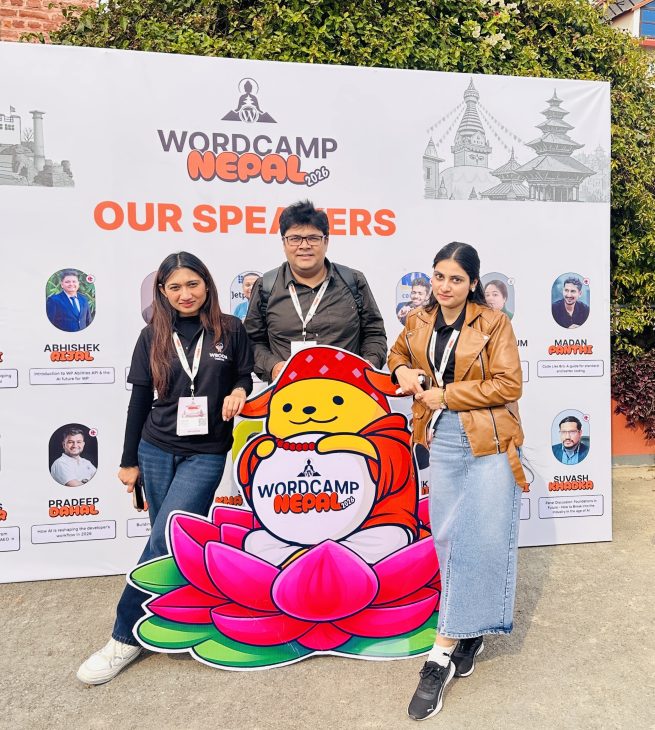
As a project manager at Wbcom Designs, my days revolve around coordinating with clients, managing deliverables, and making sure every WordPress project we take on runs smoothly from kickoff to launch. I spend a lot of time on calls, explaining timelines, walking clients through features, and sometimes simply reassuring them that WordPress is the right choice for their business. It is a role that demands clarity, confidence, and a deep understanding of the platform we build on every day.
For years, I have been immersed in the world of WordPress, learning something new every day, whether it is experimenting with plugins, refining workflows, or analysing how features impact real users. Yet, until WordCamp Nepal 2026, I had never been part of a WordCamp. I had always pictured it as a melting pot of ideas, energy, and collaboration, where professionals from around the country gather to share insights and inspiration. The thought of being surrounded by fellow WordPress enthusiasts filled me with excitement and curiosity. Would it live up to the hype I had heard about?
This first WordCamp promised to be a window into a world I had only read about online, and I could not wait to step in and experience it for myself. What I did not expect was how profoundly it would change the way I talk about WordPress with clients, and how much more confident I would feel doing it.
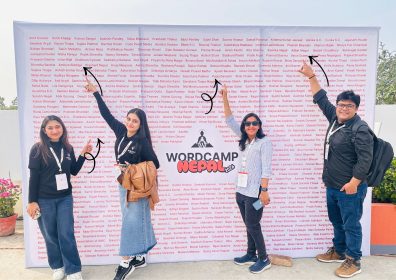
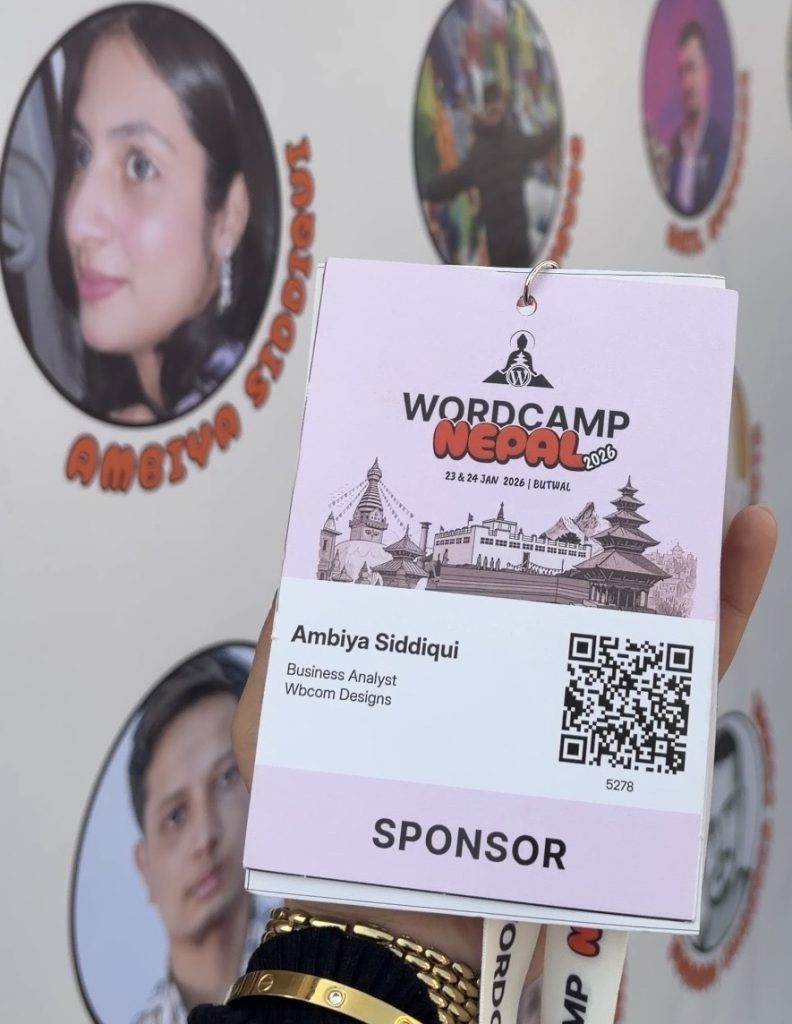
As a project manager, I am used to being behind the scenes, making sure things happen on time and within scope. But standing at WordCamp as a sponsor representative gave me a different kind of visibility. People came up to our badge, asked about Wbcom Designs, and were genuinely curious about the plugins and themes we build. Some had already used our BuddyPress solutions on their own projects, which was a wonderful surprise. It reminded me that the work we do every day matters to a much larger community than I sometimes realise. That feeling of pride stayed with me throughout the event and gave me a renewed sense of purpose in my role.
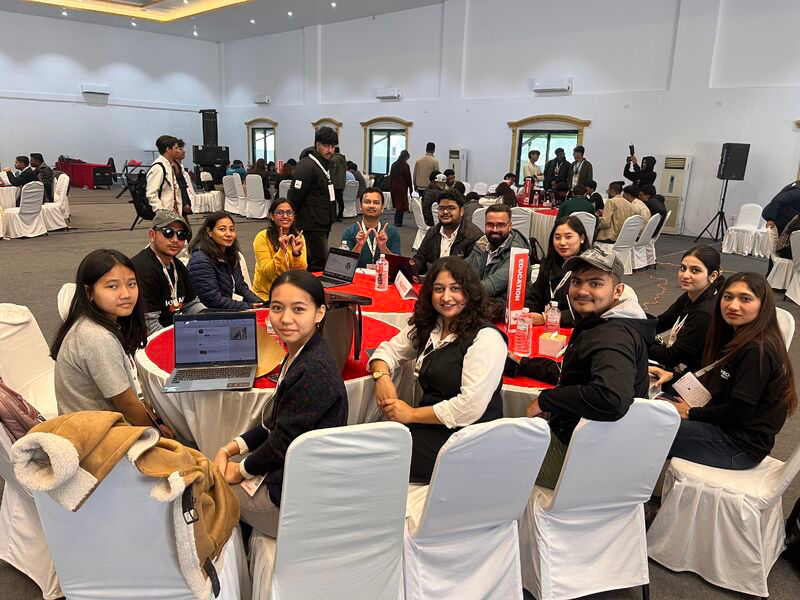
I moved from table to table, listening, asking questions, and picking up valuable insights along the way. The conversations felt open and welcoming, and no question ever felt too small. One moment that stood out was meeting Pooja Derashri at the education table. She walked us through initiatives like WordPress Campus Connect, Student Clubs and WP Credits, and hearing how these programs support learners and contributors really changed how I see education within WordPress. From my day-to-day experience working with WordPress, it was refreshing to see how much thought and care go into helping people grow through the platform.
What struck me the most about Contributor Day was how practical it felt. These were not abstract conversations about open source philosophy. People were actively translating WordPress into Nepali, reviewing plugin code, writing documentation, and teaching newcomers how to submit their first patch. As someone who manages projects for a living, I could see the discipline and coordination behind it all. It was community-driven project management at its finest, and it gave me a new appreciation for how WordPress stays reliable and evolves so consistently. The zeal, patience, and shared passion throughout the day made Contributor Day a truly inspiring way to start the event.
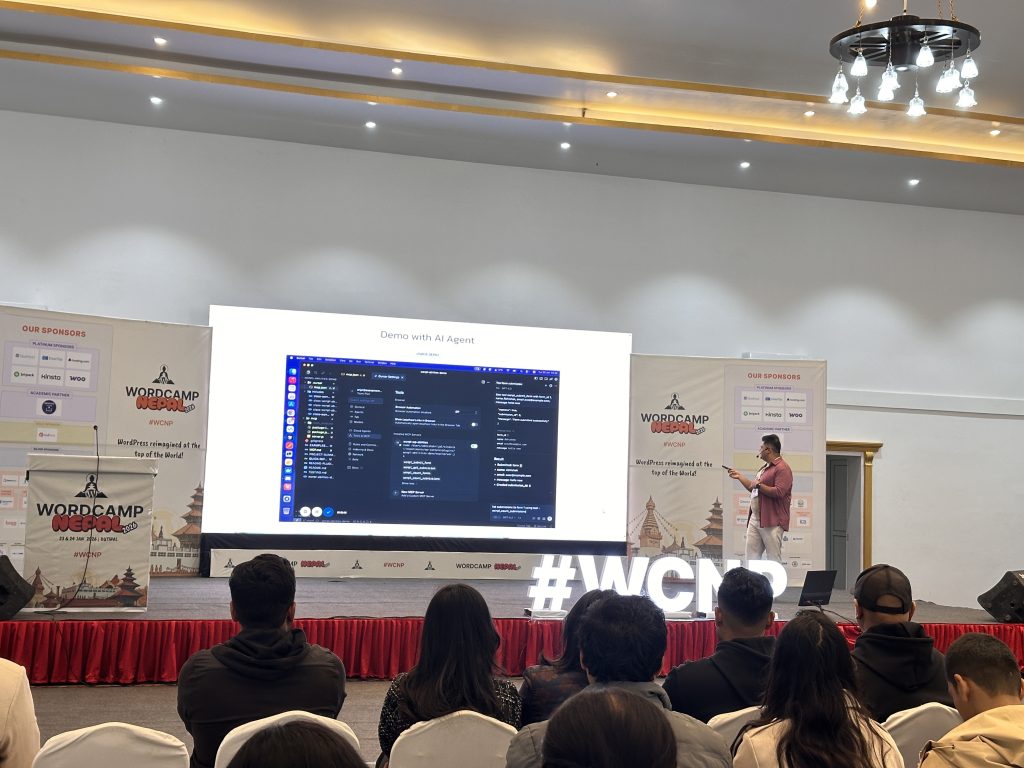
Beyond the Abilities API session, what stood out about Conference Day was the variety of perspectives in the room. There were freelancers, agency owners, in-house developers, and people like me who work on the project management side. Each person brought a different lens to the same topics, and that diversity of viewpoints made the discussions richer. I found myself taking notes not just on technical details, but on how different professionals think about WordPress in their own context.
From my perspective as someone who works with WordPress daily, this session helped me think beyond traditional setups and see how WordPress is evolving alongside AI. It showed me how future-ready WordPress can be when combined with intelligent automation, and how these tools can simplify complex processes while improving productivity.
I walked away with a clearer understanding of where WordPress is headed and how I can start preparing for that future in my own work. But more importantly, I walked away with stories and real examples I could share with my clients, things that go far beyond what any sales pitch could achieve.
There is a difference between saying “WordPress is scalable” because you read it in documentation, and saying it because you sat in a room full of developers, agency owners, and contributors who are actively building the infrastructure that makes it scalable. WordCamp gave me that difference. It gave me conviction.
During client calls, I often get questions like: “What if we outgrow WordPress?” or “Is WordPress secure enough for our business?” or “Why not just use a SaaS platform instead?” These are fair questions, and clients deserve thoughtful answers. After WordCamp, I found myself answering them differently. I was not just reciting features. I was sharing what I had seen and heard from people who live and breathe WordPress every single day. I could talk about the security discussions happening at Contributor Day tables, the AI integrations being built into core APIs, and the education programs preparing the next generation of WordPress professionals.
That kind of confidence does not come from reading blog posts or watching webinars. It comes from being in the room, hearing the conversations, and understanding the direction the platform is heading. WordCamp Nepal gave me exactly that, and it has made a noticeable difference in how I communicate with clients. When I speak about WordPress now, I am not selling a platform. I am sharing something I genuinely believe in, and clients can feel that difference.
Is WordPress Scalable?
This is probably the question I hear most often, especially from clients planning to grow their business. The short answer is yes, absolutely. WordPress powers over 40% of the web, and that includes everything from personal blogs to enterprise-level platforms handling millions of visitors. At WordCamp, I met developers who manage WordPress installations serving thousands of concurrent users with complex workflows, membership systems, and e-commerce operations running seamlessly.
What gave me even more confidence was seeing the architectural direction WordPress is taking. The REST API, the block editor, and now the Abilities API are all designed with scale in mind. WordPress is not just keeping up with modern web demands; it is actively being built to handle them. When a client asks me if their membership site or online store can grow on WordPress, I no longer hesitate. I have seen the proof.
Is WordPress Secure?
Security is another topic that comes up in almost every client conversation, and understandably so. No one wants to invest in a platform that leaves their data vulnerable. What I learned at WordCamp Nepal is that WordPress security is not an afterthought. It is a constant, community-wide effort. There are dedicated teams working on core security, plugin reviewers catching vulnerabilities before they reach users, and contributors actively writing documentation to educate developers on secure coding practices.
During Contributor Day, I saw first-hand how the plugin review process works and how seriously the community takes security standards. Regular updates, a massive ecosystem of security plugins, and the sheer number of eyes reviewing code all contribute to making WordPress a platform you can trust with your business. Of course, security also depends on how well a site is maintained, but the foundation WordPress provides is solid and continuously improving.
What Are the Possibilities?
This is where WordPress truly shines, and where WordCamp opened my eyes even further. WordPress is not just a blogging tool or a basic website builder anymore. It is a full application framework capable of powering e-commerce stores, learning management systems, social networks, membership platforms, booking systems, job boards, and so much more. At Wbcom Designs, we build BuddyPress-powered community platforms, and I have seen first-hand how flexible WordPress can be when you push it beyond the basics.
What excites me the most after attending WordCamp is the direction WordPress is heading with AI integration. The WP Abilities API session showed me that WordPress is preparing to become a platform where AI agents can interact with site capabilities, automate repetitive tasks, and create intelligent workflows. For clients, this means their WordPress investment today is not just solving current problems; it is positioning them for a future where their website can do more with less manual effort.
When clients ask me what is possible with WordPress, I now have a much richer answer. It is not just about what WordPress can do today. It is about what it is becoming, and the community behind it is making sure that evolution never stops.
Insight came from the sessions and the hallway conversations between them. Every talk I attended added a new layer to my understanding of WordPress, not just as a tool, but as an ecosystem. I learned about accessibility initiatives, translation efforts, education programs, and the technical roadmap for WordPress core. These are things you do not fully appreciate until you see the people behind them and hear their passion for the work they do.
Feedback came naturally from the conversations I had with other professionals. When I mentioned that I work as a project manager for a WordPress product company, people were genuinely interested in our workflow, our challenges, and our approach. Some shared their own experiences and offered suggestions. Others asked about our plugins and gave honest opinions about features they liked or improvements they would want to see. That kind of direct, informal feedback is incredibly valuable and something you rarely get from online interactions alone.
Direction came from understanding where WordPress is headed. Hearing about the Abilities API, the growing focus on AI, and the community’s commitment to education and inclusivity gave me a clearer picture of what to expect in the coming years. As a project manager, this helps me plan better, advise clients more accurately, and align our team’s efforts with the broader direction of the platform we build on.
I think every professional working in the WordPress space, whether you are a developer, designer, marketer, or project manager, would benefit from attending at least one WordCamp. The professional growth that comes from these events is not something you can replicate through online courses or documentation. It is the human connection, the shared enthusiasm, and the unfiltered exchange of ideas that make the difference.
The community is not standing still. WordPress is actively evolving to embrace AI, improve performance, enhance accessibility, and support modern development workflows. The block editor continues to mature, the REST API enables headless and hybrid architectures, and initiatives like the Abilities API are preparing WordPress for a future where automation and intelligent agents play a central role. These are not distant possibilities. They are being built right now, by real people I met at WordCamp.
What makes WordPress different from other platforms is its community. There is no single company deciding the future of WordPress in isolation. It is shaped by thousands of contributors from around the world, people who use it, build on it, and care about its long-term success. That decentralised, community-driven approach is what makes WordPress resilient. It adapts because the people behind it are constantly listening, learning, and contributing.
For someone in my role, this matters deeply. When I sit on a call with a client who is deciding between WordPress and a proprietary platform, I am not just comparing feature lists. I am comparing ecosystems. WordPress offers something that no closed platform can: a global community that is personally invested in making the platform better, year after year. And after seeing that community in action at WordCamp Nepal, I can say that with complete honesty.
For me personally, this means I can recommend WordPress to clients with even greater confidence. I am not just recommending a product. I am recommending a platform backed by a global community that is invested in its future. And that is a powerful thing to be able to say on a client call.
As a project manager, I came to WordCamp Nepal hoping to learn. I left with something far more valuable: the ability to speak about WordPress not just with knowledge, but with conviction. Every client conversation I have had since the event has felt different. I am more confident in my recommendations, more informed about the platform’s direction, and more connected to the community that makes it all possible.
I also came away with a stronger appreciation for the people who make WordPress what it is. The developers writing code at midnight, the translators making WordPress accessible in dozens of languages, the educators creating pathways for newcomers, and the organisers who bring it all together at events like WordCamp Nepal. Their work is often invisible, but it is the reason WordPress continues to thrive. Being in that room, surrounded by that energy, reminded me why I chose this path in the first place.
I move forward with renewed clarity, confidence, and a deeper appreciation for shared learning. WordCamp Nepal 2026 was not just an event I attended. It was a turning point in how I see my role, my work, and the platform I have built my career around.
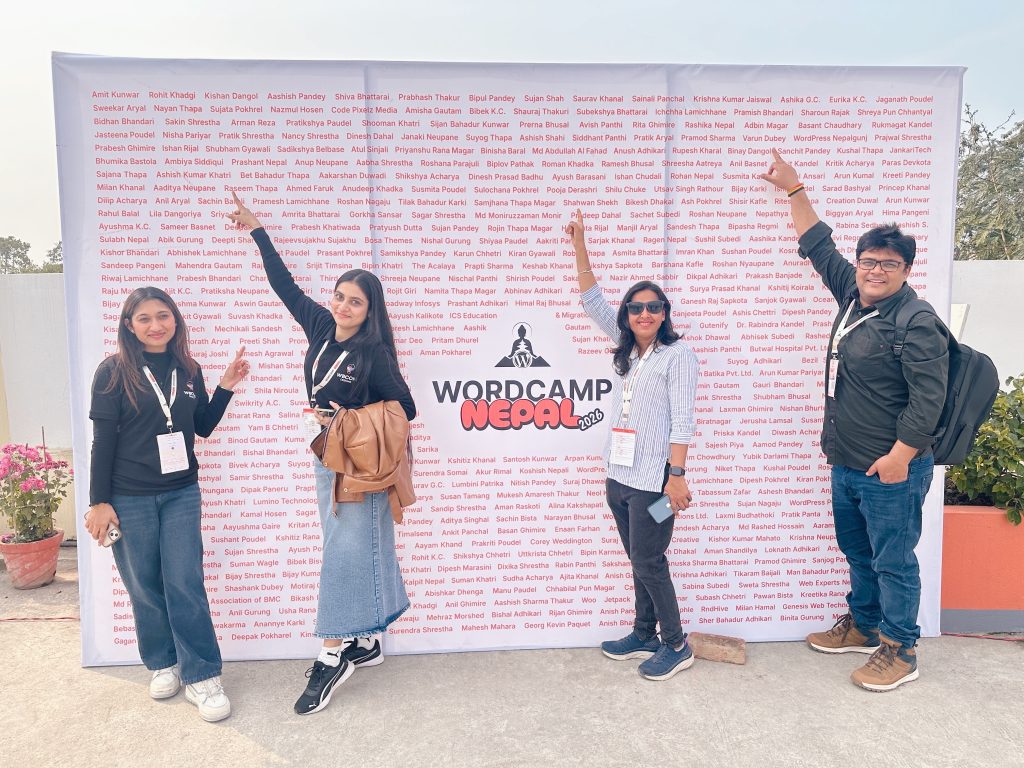
A heartfelt thank you to the organizers, volunteers, speakers, and everyone I connected with for making this WordCamp such a great experience. I am excited to attend more WordCamps and continue learning along the way.
Abilities API AI in WordPress WordCamp WordCamp Nepal WordPress community
Last modified: February 4, 2026