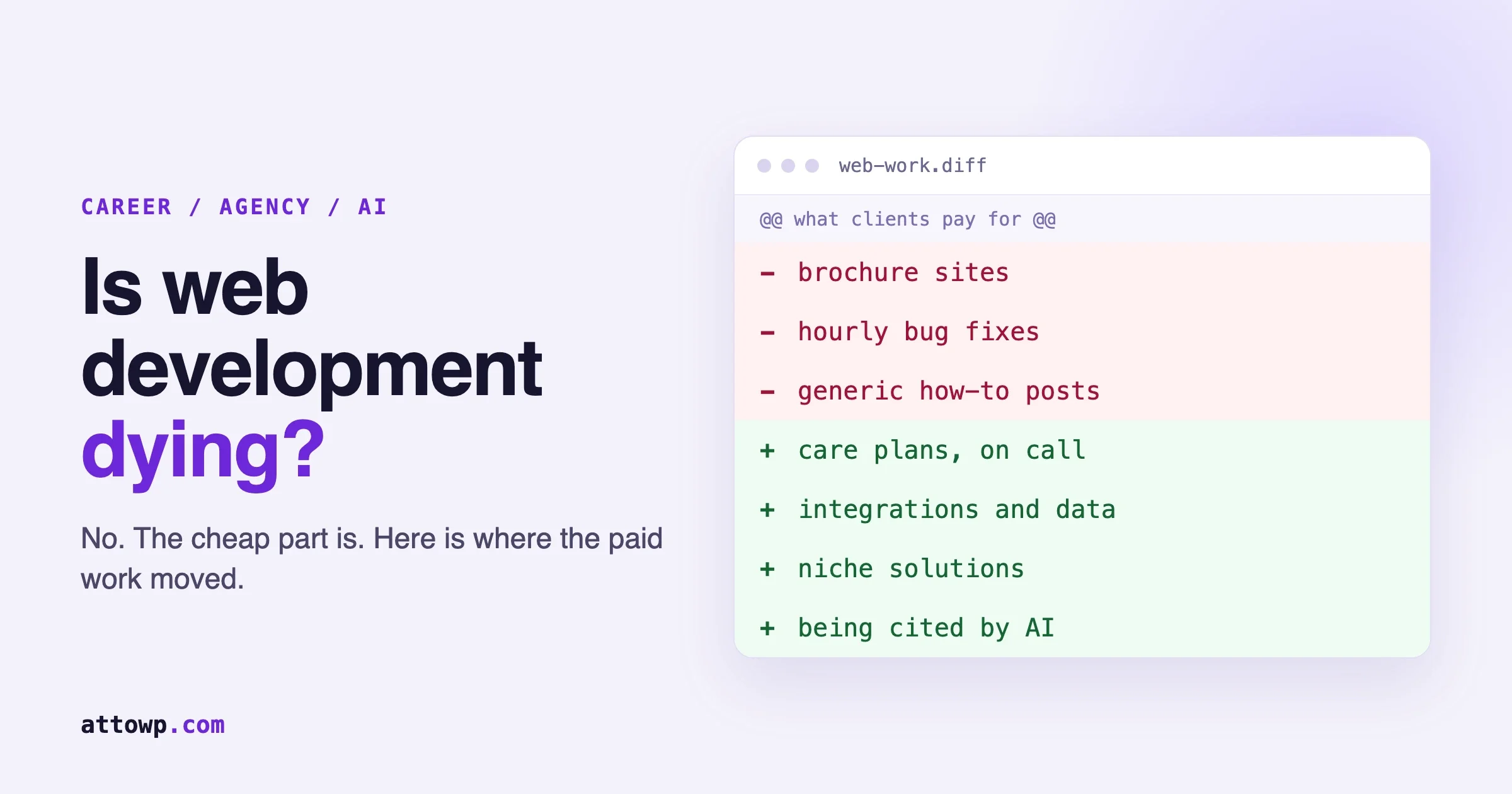
Is web development dying? No. The cheap part of it is. Typing code, setting up a theme, writing a generic “how to” post: AI now does those in minutes, so nobody pays much for them. What clients still pay for, and pay more for than before, is the person who understands their business, owns the result when it breaks, and can be found and trusted. This post is our honest read on where the work is moving for developers, freelancers, agencies and marketers, and what we are changing in our own team because of it.
We run a WordPress product and services company. We ship plugins and themes, build client platforms, and publish on more than a dozen sites. Most of what follows comes from what we saw in our own numbers this year, not from a forecast.
Key takeaways
- Code is cheap, ownership is not. AI writes the code. People are still paid to decide, check and answer for it.
- Commodity builds are shrinking. Brochure sites, theme setup and hourly fixes are the first work clients try with AI.
- Running systems is growing. Care plans, integrations, data and AI setup are recurring work that needs a named person.
- Being found has changed. AI answers come before the click. You need to be the source AI cites, not just a page that ranks.
- Niche beats generalist. “WordPress developer” is a commodity. “We build course platforms for training companies” is not.
Is web development dying? The short answer
Web development is not dying, but the job is splitting in two. One half is production: turning a clear request into working code. That half is getting cheaper every month, because AI coding agents do most of it. The other half is judgment: working out what should be built, wiring it into the rest of the business, keeping it running, and being accountable when it fails. That half is getting more valuable, because there is now far more software in the world that somebody has to own.
People search “is web development dying” a few hundred times a month in the US alone. The worry is real. But look at what is actually happening on client sites. Owners who build a site with an AI builder still call someone when the checkout fails, when Google stops indexing their pages, or when a plugin update breaks the members area. The call did not go away. It moved from “build me a site” to “make this thing work and keep it working”.
So the useful question is not whether the work exists. It is which work you are selling.
Will AI replace web developers?
AI will replace developers whose whole offer is typing code from a spec. It will not replace developers who can do the parts around the code. We see this inside our own team every week. Our agents write most first drafts of a fix. A person still decides whether the fix is right, checks it in a real browser at a phone width, reads every place the change reaches, and signs off the release. When something slips through, a person answers the customer.
We wrote about how that changes the daily job in what the developer’s job becomes when agents write the code. The short version: the job moves from writing to deciding, checking and owning. Developers who lean into that become more productive than they have ever been. Developers who compete with the agent on speed lose.
There is a second, quieter shift. Clients now arrive with half-built things. A founder vibe-codes an app in a weekend, or a marketer builds a landing page with an AI builder. It works in the demo. Then it needs a database that will not lose orders, real logins, backups, and someone on call. “Finish it and keep it running” is a new kind of work that did not exist two years ago.
What is shrinking
Be honest about this list. If most of your income sits here, the next 12 months will feel tight.
Commodity builds
Brochure sites, “install this theme and import the demo”, “add these five plugins”, small CSS fixes billed by the hour. Clients now try these with AI first. They call a person only when it goes wrong, and by then they expect a lower price, because “the AI did most of it”.
Generic how-to content
“How to add a contact form in WordPress” used to bring steady traffic. Now Google’s AI Overviews and ChatGPT answer it on the spot, and the click never happens. We covered the traffic data in our post on AI Overviews and publisher revenue. Our own checks this month told the same story from the other side: many specific phrases we wanted to target show almost no search volume at all. People ask an assistant instead of typing a query.
Single-purpose plugins and apps
A plugin that does one small thing is now easy to copy. A widely shared Reddit thread this autumn had a SaaS founder admitting that features they spent years building can be cloned by an agent in a weekend. A plugin founder also shared acquisition due diligence on X showing new-customer revenue flat or falling across both WordPress plugins and Shopify apps. That is a secondhand report, not audited data, but it matches what we see when we compare our own products: small, standalone add-ons sell less, while connected suites hold up.
Marketing that only chases rankings
Ranking on page one matters less when the answer appears before page one. A marketer whose whole plan is “more keywords, more posts” is fighting the wrong battle.
What is growing
This is where we are putting our own time, and where we see clients spend.
1. Running the system, not just building it
Updates, security patches, backups, speed, uptime, small changes, and a person who picks up the phone. This is recurring work, it needs accountability, and AI cannot take the blame for a hacked store. Every big security week shows it. When several supply-chain incidents land in the same week, site owners do not want a tutorial. They want someone who already patched their site. US searches for “wordpress support services” carry an advertiser price above $50 a click, which tells you what that intent is worth.
If you have not priced this kind of work before, our guide on hourly, fixed and value-based pricing for WordPress projects covers retainer structures.
2. Integration and data ownership
Most businesses now run a store, a CRM, an email tool, a course platform, a booking system and three AI tools. None of them talk to each other. Connecting them so the business runs as one system, and making sure the owner actually holds their own data, is hard, specific work. AI helps you write the glue code. It does not know which system should be the source of truth for a customer’s email address.
3. Vertical depth
A generalist is hard to recommend. A specialist is easy. We are applying this to our own products right now. KnowX, our documentation theme, is being positioned for schools and research groups, paired with a member wiki and member blog so a class or lab can build a knowledge base together. That is a much clearer story than “a docs theme”, and it is the kind of story a client, a friend or an AI assistant can repeat.
4. AI-ready sites and workflows
Two kinds of work sit here. First, making sites readable by AI agents: clean structured data, an llms.txt file, and, on WordPress, the Abilities API and MCP so an agent can act on the site safely. Second, putting AI into a client’s real work: support replies, content operations, onboarding, reporting. Both need setup, permissions and guardrails. Clients will pay for that, because the risk of getting it wrong is their data.
5. Being cited, not just clicked
AI answers are built from sources that already have authority and that agree with each other. More on this below, because it changes how every freelancer and agency gets clients.
6. Proof and real people
As AI-written content floods every channel, the things AI cannot fake get more valuable: real case studies with real numbers, a live demo site a buyer can click through, a named person with a face and a track record. Your portfolio and your public work history are now sales assets, not decoration.
Shrinking work vs growing work at a glance
| Shrinking | Growing | Your move |
|---|---|---|
| Brochure sites and theme setup | Care plans and on-call support | Turn every build into a monthly plan |
| Hourly bug fixes | Owning a system end to end | Sell outcomes, not hours |
| Generic how-to posts | Decision guides and case studies | Write what only you saw |
| One small plugin | Connected suites for one use case | Package around a buyer’s job |
| Keyword-only SEO | Being cited in AI answers | Earn mentions on other sites |
| “I do WordPress” | “We build X for Y” | Pick a niche and say it everywhere |
How clients find you when AI answers first
This is the part most developers have not adjusted to yet. A business owner who needs help increasingly asks ChatGPT, Gemini or Google’s AI Mode: “who can build a membership site for my coaching business?” The assistant answers with a short list. If you are not on it, you never get the chance to pitch.
We measured this for our own community product earlier this month. The product site was technically clean: fast, correct schema, good titles. Yet when we checked which sources AI answers cited for “best WordPress community plugin”, we appeared in 0 of the 10. The sites that got cited were review roundups, Reddit threads, YouTube comparisons and directories. On-page polish was not the gap. Other people talking about us was.
Search interest in “ai visibility” and “generative engine optimization” has grown into the thousands of searches a month for exactly this reason. Here is what actually moves it, in the order we would do it:
- One clear “best for” sentence. Decide what you are best for and repeat that exact line on your homepage, your profiles, your directory listings and your bio. AI repeats what it sees repeated.
- Mentions on sites you do not own. Honest, disclosed answers in forums and Reddit threads. Listings in directories. Inclusion in roundups. Guest posts and podcast spots. These are the sources AI cites.
- Something citable. An original number, a benchmark, a survey of your own clients. Content that only you can publish gets quoted. Rewritten advice does not.
- Machine-readable facts on your own site. Make it easy for a crawler to understand who you are and what you do.
The last point is the one developers can do in an afternoon. Here is a minimal example of structured data for a small studio. It tells search engines and AI crawlers your name, what you specialise in, and where you work, in a format they parse reliably.
<script type="application/ld+json">
{
  "@context": "https://schema.org",
  "@type": "ProfessionalService",
  "name": "Example Studio",
  "url": "https://example.com/",
  "description": "We build and run course platforms for training companies on WordPress.",
  "areaServed": ["US", "GB", "IN"],
  "knowsAbout": [
    "LMS development",
    "WordPress care plans",
    "WooCommerce subscriptions"
  ],
  "sameAs": [
    "https://github.com/example-studio",
    "https://www.linkedin.com/company/example-studio"
  ]
}
</script>
Pair it with a short llms.txt file at your site root that points assistants to your best pages:
# Example Studio

> We build and run course platforms for training companies on WordPress.

## Services
- [LMS development](https://example.com/services/lms/): new course platforms and migrations
- [Care plans](https://example.com/care-plans/): updates, security, backups, support

## Proof
- [Case studies](https://example.com/work/): real projects with numbers
Neither file gets you cited on its own. They make sure that when an assistant does look at your site, it reads the same “best for” line you use everywhere else. The spec for the second file lives at llmstxt.org, and Google explains how its AI features use your pages in its Search Central guide.
A 12-month plan by role
Same shift, different moves depending on how you earn.
If you are a freelance developer
- Pick a niche you already have proof in. Look at your last ten projects. If four were membership sites, you are a membership-site developer now.
- Add a monthly offer. “I keep your course site running” at a fixed monthly fee beats chasing new builds. Start with past clients.
- Use AI to deliver faster, and price the result. If a job that took 20 hours now takes 6, do not cut your price by 70%. Charge for the outcome.
- Get mentioned. One genuinely useful answer a week in the forums where your niche asks questions does more than ten blog posts.
Our older guide on how AI is reshaping WordPress freelancing lists more service ideas in this direction.
If you run an agency
- Move from projects to platforms plus retainers. The build is now the smaller part of the margin. Discovery, architecture and ongoing care are the larger part.
- Productise your build process. Templates, starter repos and AI agents do the repeatable 70%. Your people spend their time on the 30% that is specific to the client.
- Set a recurring-revenue target. We wrote about the two numbers that decide whether an agency is profitable; recurring share is one of them.
- Sell AI setup as its own line. Agent access to client sites, content workflows, support assistants. Most clients cannot set these up safely themselves.
For the people side of that change, see our guide to scaling from solo freelancer to agency.
If you build products (plugins, themes, SaaS)
- Fewer standalone items, more connected suites. Each suite answers one buyer’s job: run a community, sell courses, run a marketplace.
- Put services next to the product. Products bring the leads; setup, migration and care plans bring a lot of the revenue.
- Run a live demo for every product. A buyer clicking through a real site is proof AI cannot generate.
- Measure new customers separately from renewals. Renewals hide a falling front door for a long time.
If you work in marketing
- Publish less, with more substance. Decision guides, comparisons, real setups and original numbers. Skip the rewrites.
- Track AI visibility, not only rankings. Pick ten questions your buyers ask an assistant and check monthly who gets named.
- Spend on presence elsewhere. Roundups, directories, YouTube and community answers are the sources AI reads.
- Keep the brand line identical everywhere. Same name, same “best for” sentence, every surface.
What we are changing at Wbcom
Advice is cheap. When we ask ourselves “is web development dying for us?”, the honest answer shows in where we now spend our time. Here is what we are actually doing with our own team over the next year.
We are packaging products into use-case solutions. Community, learning, knowledge bases, service marketplaces. Each gets its own pages that speak to one buyer, instead of a long list of plugins.
We are writing fewer generic posts. Across our sites we now favour pieces built on something we did: a migration, a release, a mistake we fixed. When search demand for a topic is near zero, we still publish if the piece positions a product clearly, but we do not pretend it is a traffic play.
We are working on presence outside our own domains. After finding ourselves in zero of ten cited sources, the plan shifted from polishing our pages to earning mentions on the sites AI already trusts.
We run AI agents across the whole company, with people owning every outcome. Agents draft code, run checks, prepare releases and do the research behind posts like this one. A person checks every change in a real browser and answers for it. That split is the core of the whole shift. If you want the long version, we wrote about what you actually sell when AI builds the website.
Common mistakes we see
Competing with AI on price
Dropping your rate to match “the AI could do it” is a race you lose. Raise the value of what you sell instead: ownership, speed of response, and results you can show.
Ignoring AI tools out of pride
The opposite mistake. Developers who refuse to use agents are now slower than peers who do, and clients notice. Use the tools; just never ship what you have not checked.
Staying a generalist because niches feel risky
A niche feels like turning work away. In practice, it is how people remember to recommend you, and how an assistant can name you for a specific question.
Treating the portfolio as finished
A portfolio from 2022 with three screenshots does not help anyone choose you. Keep adding live work, numbers and short write-ups.
Assuming “WordPress is dying” means “my skills are worthless”
WordPress share has dipped, and our sister site looked at what that drop really means. Millions of business sites still run on it, and every one of them needs care. Skills move with you: someone who can run a WordPress store well can run a headless or Shopify one too.
Need a team that builds it and keeps it running?
Wbcom Designs builds community, learning and commerce platforms on WordPress, and runs them afterwards with care plans and AI-ready setups.
FAQ
Is web development still a good career?
Yes. Asking “is web development dying” is really asking which half of the job you want. Aim at the growing half. Learn to work with AI agents, pick a niche, and learn the skills around the code: talking to clients, owning releases, security, integrations and operations. Pure “turn this spec into code” roles will keep shrinking.
Will AI replace WordPress developers?
It will replace a lot of routine WordPress work, such as theme setup and simple plugin tweaks. It will not replace developers who own complex sites, integrations and care plans, because someone still has to decide, check and take responsibility.
How do I get web design clients now?
Pick one type of client, say it clearly everywhere, and get mentioned where those clients ask questions: forums, Reddit, directories and roundups. Ask happy past clients for reviews and referrals, and turn finished builds into monthly care plans.
What is AI visibility?
AI visibility is how often an assistant such as ChatGPT, Gemini or Google’s AI Mode names you or cites your site when people ask questions in your field. It depends mostly on authority and on other sites mentioning you, not only on your own pages.
Is it better to learn a new stack or go deeper in a niche?
Go deeper in a niche first. Stacks change every few years and AI lowers the cost of switching between them. Knowing one industry’s problems well is the part that keeps its value.

No comments yet