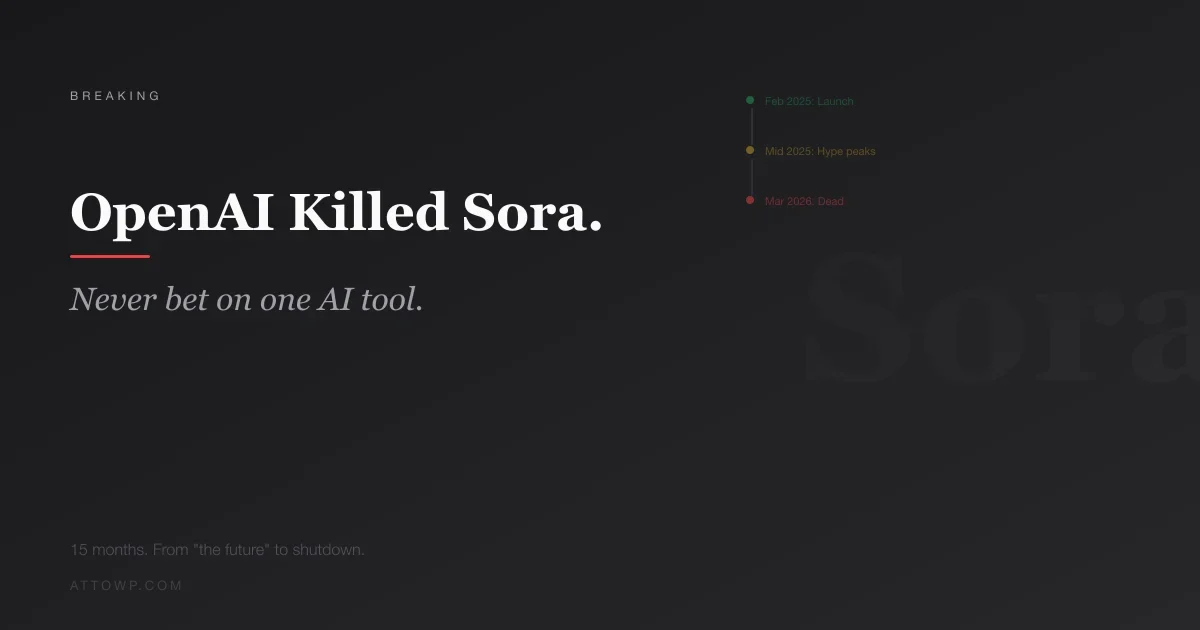
OpenAI announced this week that Sora, its AI video generation tool, is shutting down. The tool that launched in February 2025 to enormous hype, waitlists, and breathless predictions about the future of content creation is being discontinued roughly 15 months after it became publicly available. Alongside the shutdown, reports emerged that OpenAI’s billion-dollar content deal with Disney is also falling apart.
If you built workflows, products, or business plans around Sora, you are now rebuilding them around something else. If you invested time learning Sora’s specific prompt patterns, aspect ratio quirks, and generation style, that knowledge is now worthless. If you told clients that Sora was the future and built proposals around its capabilities, those proposals need rewriting.
This is not a Sora problem. This is an AI platform dependency problem. And it applies to every AI tool you are using right now.
What Actually Happened
Sora launched with genuinely impressive demos. The generated videos were smoother, longer, and more coherent than anything else on the market. The tech press declared it a game-changer. Content creators started planning entire production workflows around it. Agencies added Sora-based video services to their offerings.
Then reality set in. The generation quality was inconsistent. The moderation system was so restrictive that many creative use cases were blocked. The cost per generation was high. Competitors like Runway, Pika, and Kling shipped faster iterations with more practical feature sets. Google’s Veo and other models caught up or surpassed Sora’s quality in specific areas.
OpenAI apparently decided the unit economics did not work. Video generation requires massive compute resources, and Sora was not generating enough revenue or strategic value to justify the infrastructure cost. So they killed it.
The speed of the decision is the important part. Fifteen months from launch to shutdown. No extended sunset period. No migration path. No “Sora is transitioning to a new platform.” Just: we are done, thanks for trying it.
Why This Keeps Happening
Sora is not the first AI tool to disappear or radically change. The pattern repeats across the AI industry:
Google killed its AI code generation tool Bard and replaced it with Gemini, breaking every integration and workflow built on the Bard API. Jasper, the AI writing tool that raised $125 million in 2022, has pivoted its product so many times that early adopters barely recognize it. Stability AI’s leadership changes have made its Stable Diffusion roadmap unpredictable, with features and APIs appearing and disappearing between versions. ChatGPT’s plugin system, launched with great fanfare, was effectively replaced by GPTs, invalidating the development work of thousands of plugin creators.
The common thread is that AI companies are moving too fast for their own product stability. Models improve, strategies shift, economics change, and products get killed or transformed with minimal notice. The pace of AI development is genuinely unprecedented, which means the pace of product deprecation is also unprecedented.
The Real Risk: Workflow Dependency
Using an AI tool is not the risk. Depending on a specific AI tool for a critical workflow is the risk. The distinction matters.
A developer who uses Claude for code generation but structures their workflow so any LLM could substitute is using AI wisely. The code they produce does not depend on Claude. Their process is AI-assisted, not AI-dependent. If Claude changes its pricing, its API, or its capabilities, the developer switches tools and keeps working.
A content team that built their entire video production pipeline around Sora, trained their editors on Sora’s specific workflow, sold Sora-based services to clients, and stored Sora-specific templates and prompts, was AI-dependent. When Sora died, their pipeline died with it.
The same logic applies to WordPress developers using AI tools. If your plugin development workflow depends on a specific AI model’s behavior, you have a dependency. If your debugging process only works with one AI tool because your prompts are tuned to its specific strengths, you have a dependency. If your client proposals promise results based on a specific AI tool’s capabilities, you have a dependency.
The “Try Everything” Approach
The correct response to AI platform instability is not to avoid AI tools. It is to use many of them and depend on none of them. Here is what that looks like in practice:
Evaluate new tools continuously. When a new AI coding assistant, image generator, or automation tool launches, spend an hour testing it against your actual workflow. Not reading about it. Testing it. You need firsthand experience with multiple tools to make informed decisions about which one to use for each task.
Keep your prompts portable. Write prompts that describe what you need, not how a specific model should generate it. “Generate a WordPress REST API endpoint that handles user authentication with JWT” works across any coding AI. “Use your knowledge of WordPress hooks to generate...” is model-specific. Portable prompts mean you can switch tools without rewriting your entire prompt library.
Store outputs, not tool-specific assets. When an AI generates something useful, save the output in a tool-agnostic format. The generated code, the design, the text. Do not save Sora project files that only work in Sora. Do not save Midjourney prompt chains that only make sense in Midjourney. Your library of useful AI outputs should outlive any individual tool.
Build workflows around tasks, not tools. Your content creation workflow should be: research, outline, draft, edit, publish. The AI tool that assists with each step can change without changing the workflow. If you built your workflow as: “Open Sora, generate video, upload to editor, add Sora-specific transitions,” you married the tool to the process. Now you are divorced.
Maintain manual capability. For every task you use AI for, retain the ability to do it without AI. Not because you should do it manually, but because the fallback capability is what makes you resilient. The developer who can write code without Copilot is not threatened when Copilot changes. The developer who cannot write code without Copilot is in trouble.
What This Means for WordPress Development
The WordPress ecosystem is increasingly integrated with AI tools. Block generation, content creation, code review, security scanning, SEO optimization, and customer support are all being AI-assisted. This is good. The productivity gains are real.
But every integration point is a dependency risk. If you use an AI-powered SEO plugin that depends on a specific model’s API, what happens when that model changes its pricing or capabilities? If your theme builder uses AI generation that depends on a specific service, what happens when that service pivots or shuts down?
The WordPress community has always valued open source, self-hosting, and platform independence. These values are more important than ever in the AI era. Tools that keep the AI model interchangeable, that run locally when possible, that do not lock your data into a specific AI service, are the ones that will survive the inevitable shakeout of AI tools and companies.
The Only Safe Bet
OpenAI killed Sora. They might kill other products too. So might Anthropic, Google, Meta, and every other AI company. The technology is evolving too fast for any product commitment to be permanent.
The only safe bet is on your own skills, your own judgment, and your own ability to adapt. Use every AI tool that makes you more productive. Master the workflow, not the tool. Keep your outputs portable and your processes tool-agnostic. And never, ever build a critical business process on the assumption that any specific AI product will exist next year.
Sora’s death is not a tragedy. It is a lesson. The next tool that dies might be one you depend on right now. Make sure you are ready.

No comments yet